
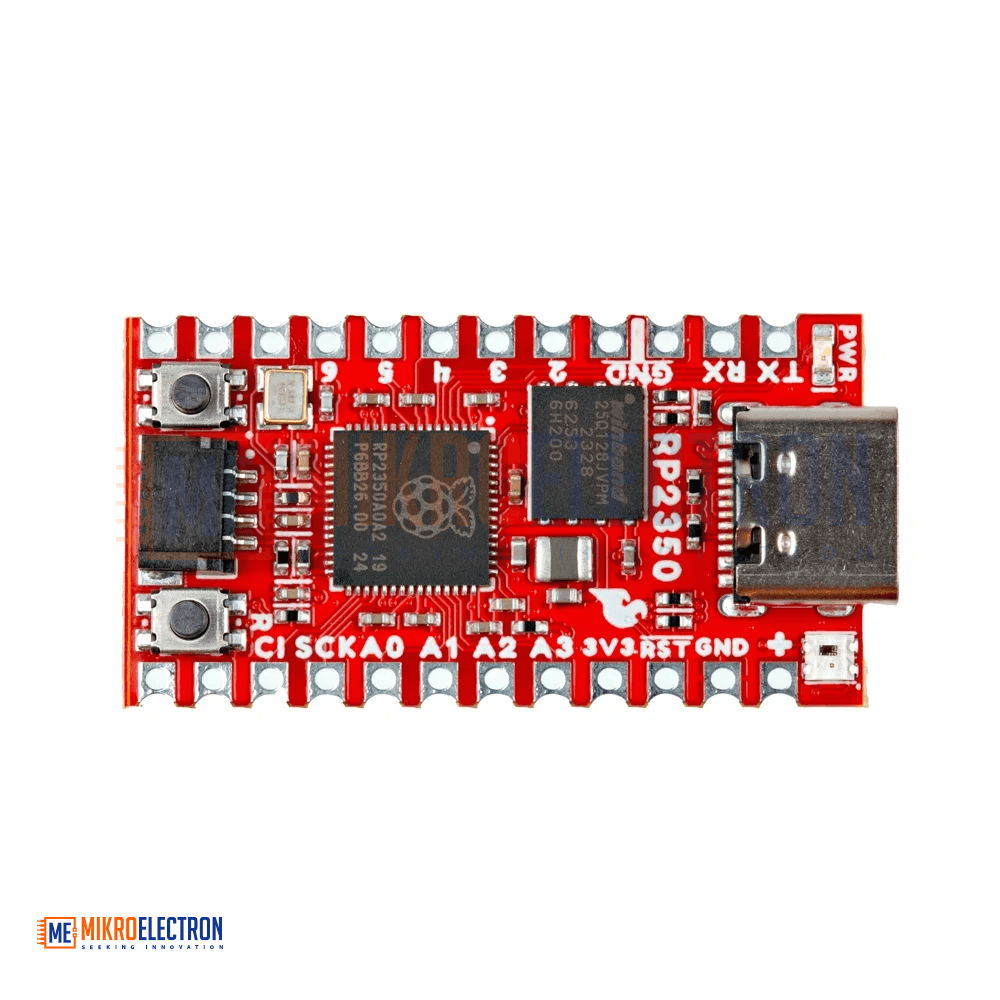
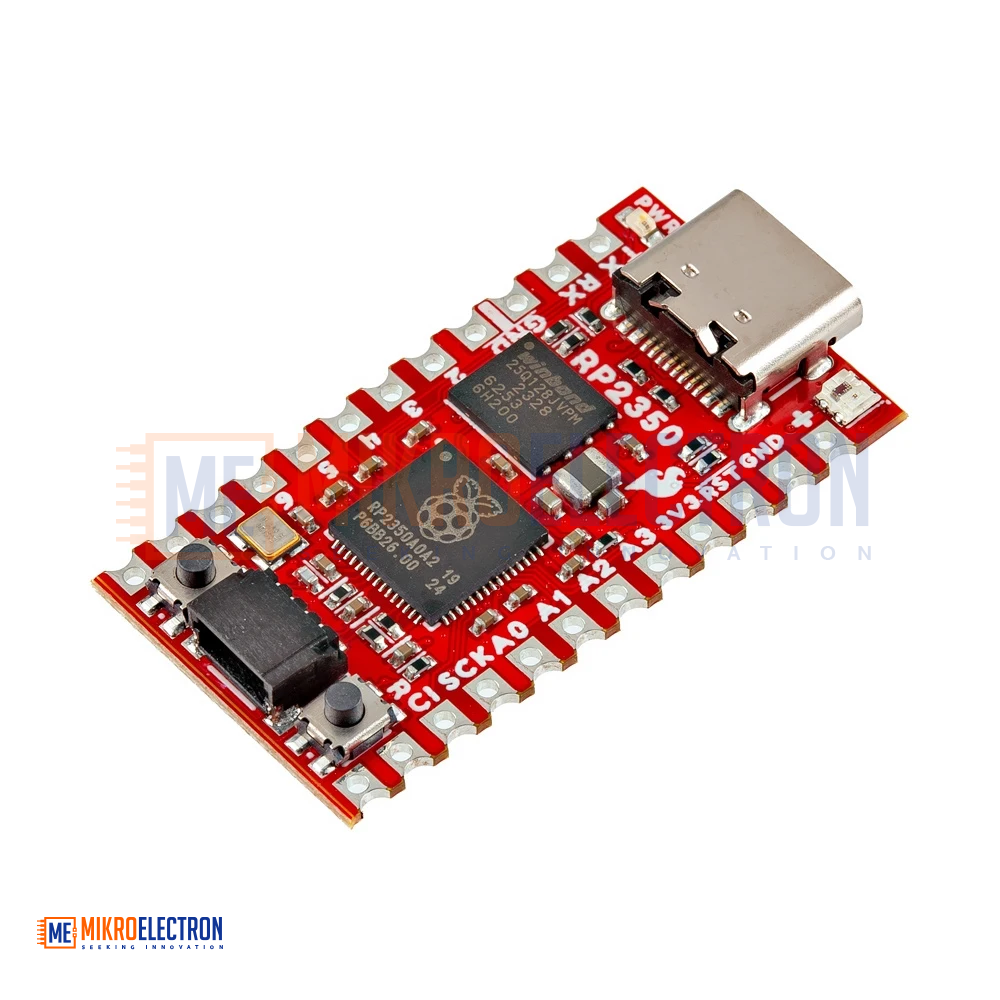
SparkFun Pro Micro - RP2350
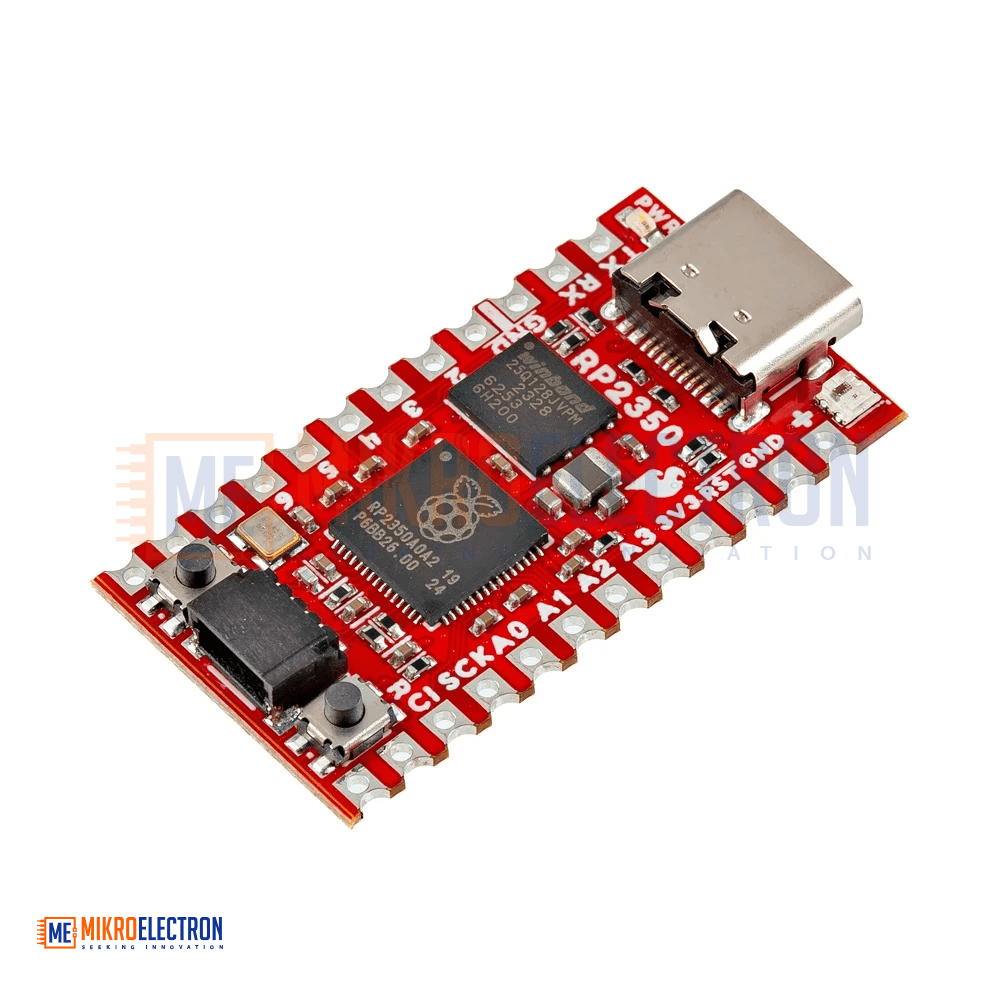
The SparkFun Pro Micro - RP2350 brings the Raspberry Pi RP2350 microcontroller to the classic compact Pro Micro form factor. It features a unique user-selectable dual-core architecture, letting you boot with two Arm Cortex-M33 cores, two Hazard3 RISC-V cores, or one of each, all running up to 150 MHz. The board includes 520kB SRAM, 16MB Flash, and 8MB PSRAM, plus a USB-C connector, Qwiic connector, addressable WS2812B RGB LED, and Boot/Reset buttons. With both PTH pins and castellated pads, it works on a breadboard or surface-mounts directly onto your own PCB.
يوفر SparkFun Pro Micro - RP2350 قوة متحكم Raspberry Pi RP2350 ضمن شكل لوحة Pro Micro المدمج والكلاسيكي. يتميز ببنية ثنائية النواة قابلة للاختيار من قبل المستخدم، حيث يمكنك التشغيل بنواتي Arm Cortex-M33، أو نواتي Hazard3 RISC-V، أو واحدة من كل نوع، بسرعة تصل إلى 150 ميجاهرتز. تحتوي اللوحة على 520 كيلوبايت SRAM و16 ميجابايت فلاش و8 ميجابايت PSRAM، إضافة إلى منفذ USB-C وموصل Qwiic وليد WS2812B RGB قابل للعنونة وأزرار Boot وReset. كما تدعم منافذ PTH والحواف المسننة (Castellated) للتركيب على البردبورد أو اللحام السطحي المباشر على لوحتك.
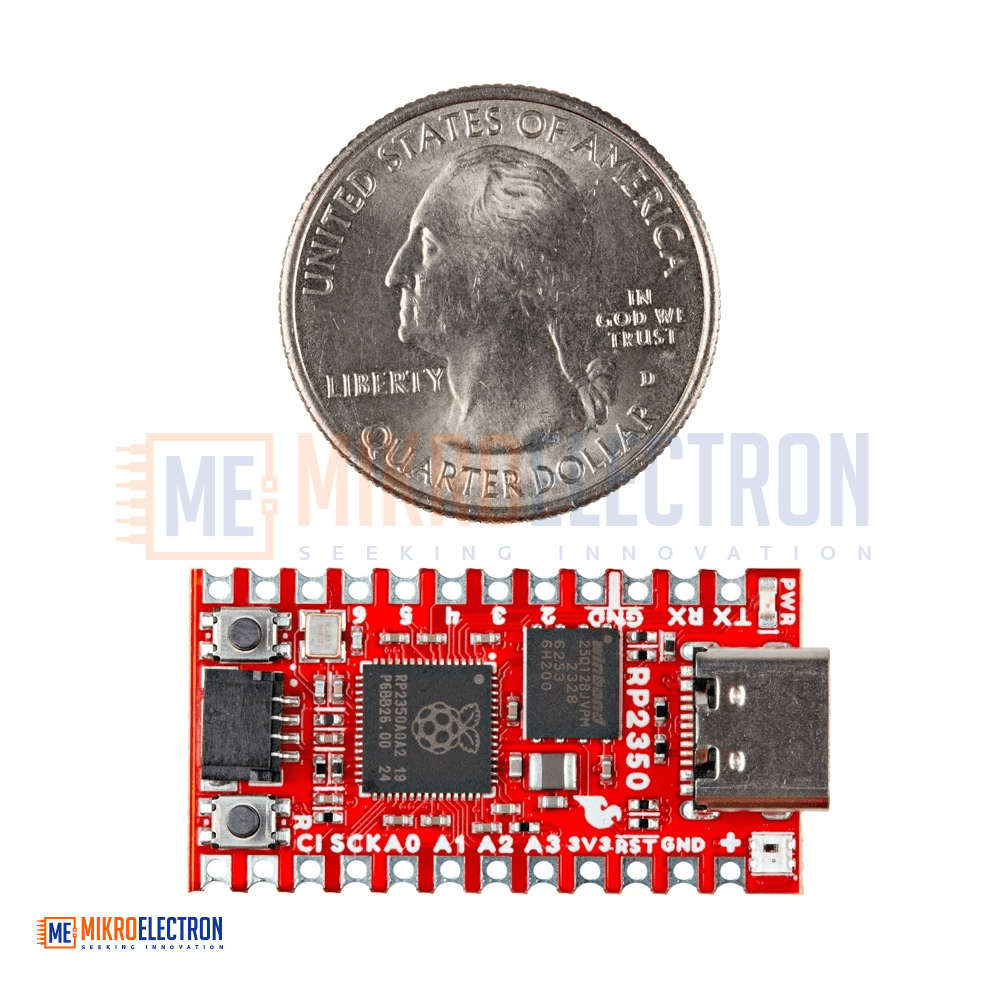
The SparkFun Pro Micro - RP2350 is a major upgrade to the well-known Pro Micro family, packing the Raspberry Pi RP2350 microcontroller into a tiny, breadboard-friendly, and surface-mountable board. It combines processing flexibility, generous memory, and modern connectivity in a footprint of just 1.3in x 0.7in (33.02mm x 17.78mm).
The headline feature is the RP2350's core flexibility. This is not a quad-core MCU; instead you select at boot which two processors will run: a pair of Arm Cortex-M33 cores, a pair of Hazard3 RISC-V cores, or one of each. All cores run at up to 150 MHz, which means you can develop, benchmark, and test across two completely different architectures using a single board. The RP2350 also provides 520kB of SRAM in 10 banks, 2x UART, 2x SPI, 2x I2C, a USB 1.1 controller with host and device support, 24 PWM channels, and 12 PIO state machines for custom hardware-timed protocols.
Memory is unusually generous for this size class. The board carries 16MB of external Flash and 8MB of PSRAM on the RP2350's QSPI controller, giving you room for complex MicroPython applications, large frame or data buffers, audio samples, and extensive Arduino projects that would not fit on a conventional microcontroller.
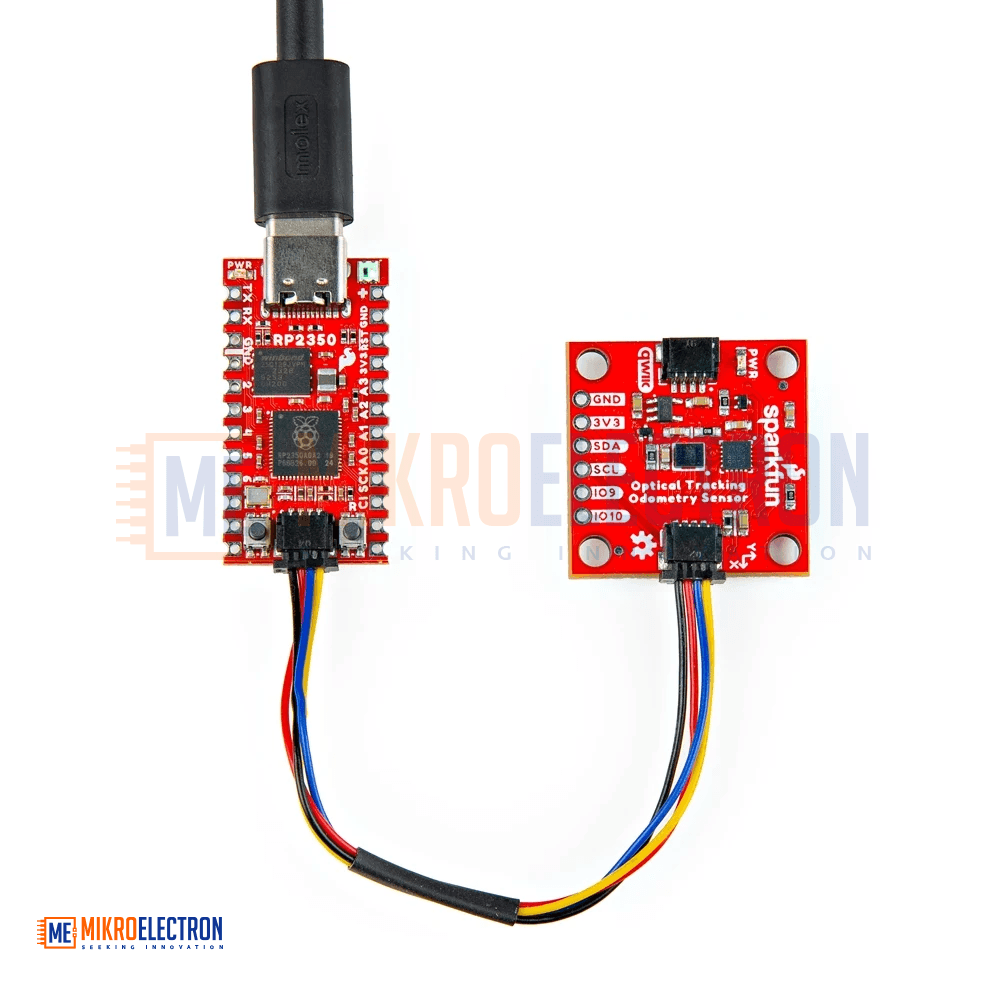
On the connectivity side, a reversible USB-C connector handles power and programming, while the built-in Qwiic connector provides plug-and-play I2C access to the full SparkFun Qwiic ecosystem of sensors, displays, and actuators without soldering. An onboard WS2812B addressable RGB LED gives colorful user status feedback, a red power LED confirms supply, and dedicated Boot and Reset buttons simplify programming. A resettable PTC fuse protects the board against overcurrent conditions.
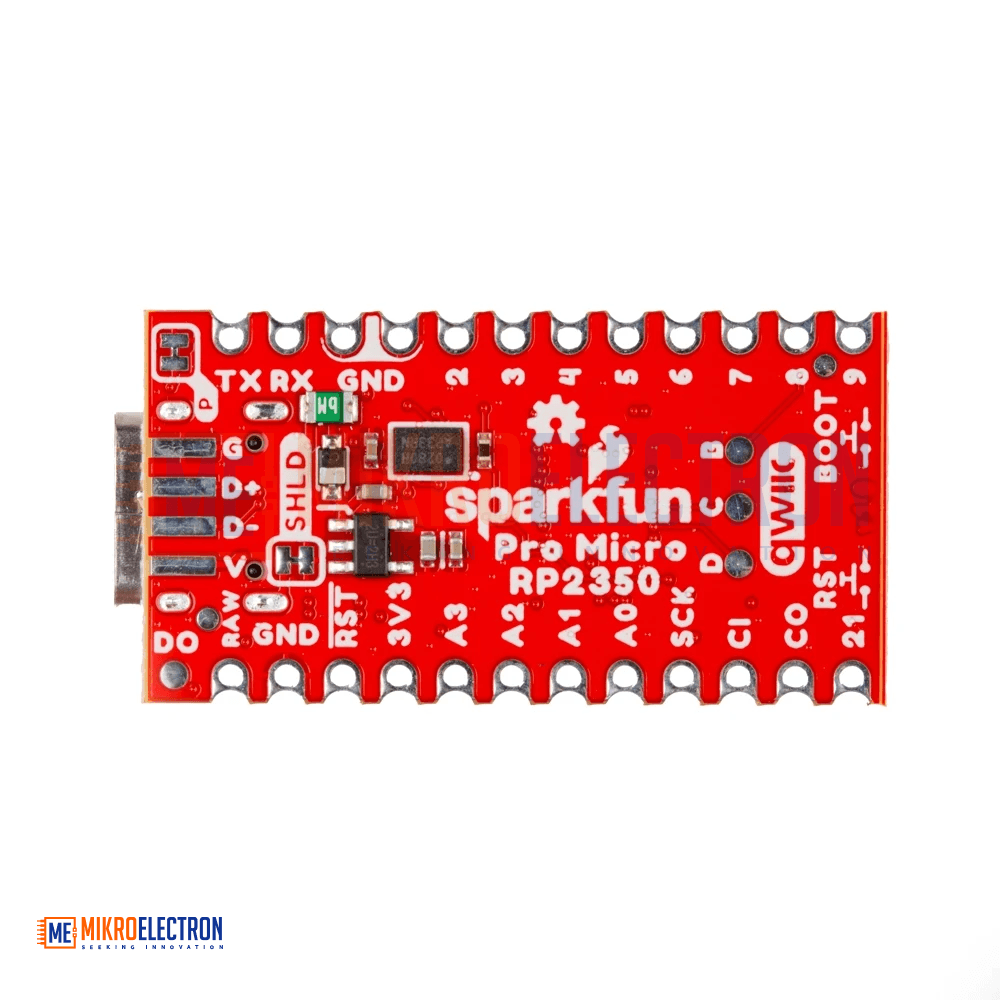
For integration, the board offers standard 0.1"-spaced plated through-hole (PTH) pins for headers and breadboards, plus castellated edge pads so the entire module can be reflow-soldered directly onto a parent PCB for a low-profile, permanent installation. Software support is complete across C/C++ with the Raspberry Pi Pico SDK, MicroPython, and the Arduino environment.
Specifications
| Parameter | Specification |
|---|---|
| Microcontroller | Raspberry Pi RP2350 |
| Processor Cores | Dual Arm Cortex-M33 and dual Hazard3 RISC-V – user-selectable at boot (2x M33, 2x RISC-V, or 1 of each) |
| Max Clock Speed | 150 MHz |
| Internal SRAM | 520kB in 10 banks |
| External Flash | 16MB (QSPI) |
| PSRAM | 8MB (QSPI) |
| GPIO Logic Level | 3.3V tolerant |
| Supply Voltage (USB) | 5V |
| Supply Voltage (RAW) | 5.3V MAX |
| USB Connector | USB-C, USB 1.1 Host/Device support |
| I2C Connector | Qwiic connector |
| Board Pinout | Pro Micro pinout: 2x UART, 1x SPI, 10x GPIO (4 used for UART0/UART1), 4x Analog |
| RP2350 Peripherals | 2x UART, 2x SPI, 2x I2C, 24x PWM channels, 12x PIO state machines |
| LEDs | WS2812B addressable RGB LED, Red power LED |
| Buttons | Reset, Boot |
| Protection | Resettable PTC fuse |
| Mounting Options | PTH 0.1"-spaced pins and castellated edge pads |
| Software Support | C/C++ (Pico SDK), MicroPython, Arduino |
| Dimensions | 1.3in x 0.7in (33.02mm x 17.78mm) |
Applications
- Embedded systems education and dual-architecture (Arm vs. RISC-V) comparison and benchmarking
- Wearable and space-constrained projects where a full-size development board will not fit
- Custom PCB integration as a surface-mounted module using the castellated pads
- Qwiic-based sensor networks – environmental monitoring, motion sensing, distance measurement
- Data logging applications benefiting from 16MB Flash storage
- Addressable LED control and lighting effects using PIO state machines
- USB HID devices – custom keyboards, macro pads, game controllers, and input peripherals
- USB host projects using the RP2350's USB 1.1 host mode
- Robotics and motor control using the 24 PWM channels
- Audio and signal buffering applications that require the extra 8MB PSRAM
- MicroPython prototyping and rapid product development
- IoT node hardware and portable battery-powered instruments