
SparkFun Allband GNSS RTK Breakout - ZED-X20P (Qwiic)
The SparkFun Allband GNSS RTK Breakout features the u-blox ZED-X20P-01B, built on the new X20 engine that succeeds the popular F9. This all-band, high-precision receiver concurrently processes GPS, Galileo, BeiDou, QZSS, and NavIC signals across all GNSS frequency bands, including L-band. It supports RTK, PPP-RTK, and PPP positioning, standard RTCM corrections for Network RTK (VRS) or a local base, and native L-band correction services without an external receiver. Multi-layered security includes Root of Trust, secure boot, jamming and spoofing detection, and Galileo OSNMA authentication. It is a near drop-in replacement for the ZED-F9P breakout.
تعتمد لوحة SparkFun Allband GNSS RTK Breakout على وحدة u-blox ZED-X20P-01B المبنية على محرك X20 الجديد، خليفة محرك F9 الشهير. يعالج هذا المستقبل عالي الدقة إشارات GPS وGalileo وBeiDou وQZSS وNavIC بشكل متزامن عبر جميع نطاقات ترددات GNSS بما فيها نطاق L-band. ويدعم تقنيات RTK وPPP-RTK وPPP وتصحيحات RTCM القياسية لشبكات Network RTK (VRS) أو محطة أساس محلية، إضافة إلى دعم أصلي لخدمات تصحيح L-band دون الحاجة لمستقبل خارجي. كما يوفر حماية متعددة الطبقات تشمل Root of Trust والإقلاع الآمن وكشف التشويش والانتحال ومصادقة Galileo OSNMA، ويُعد بديلاً مباشراً تقريباً للوحة ZED-F9P.
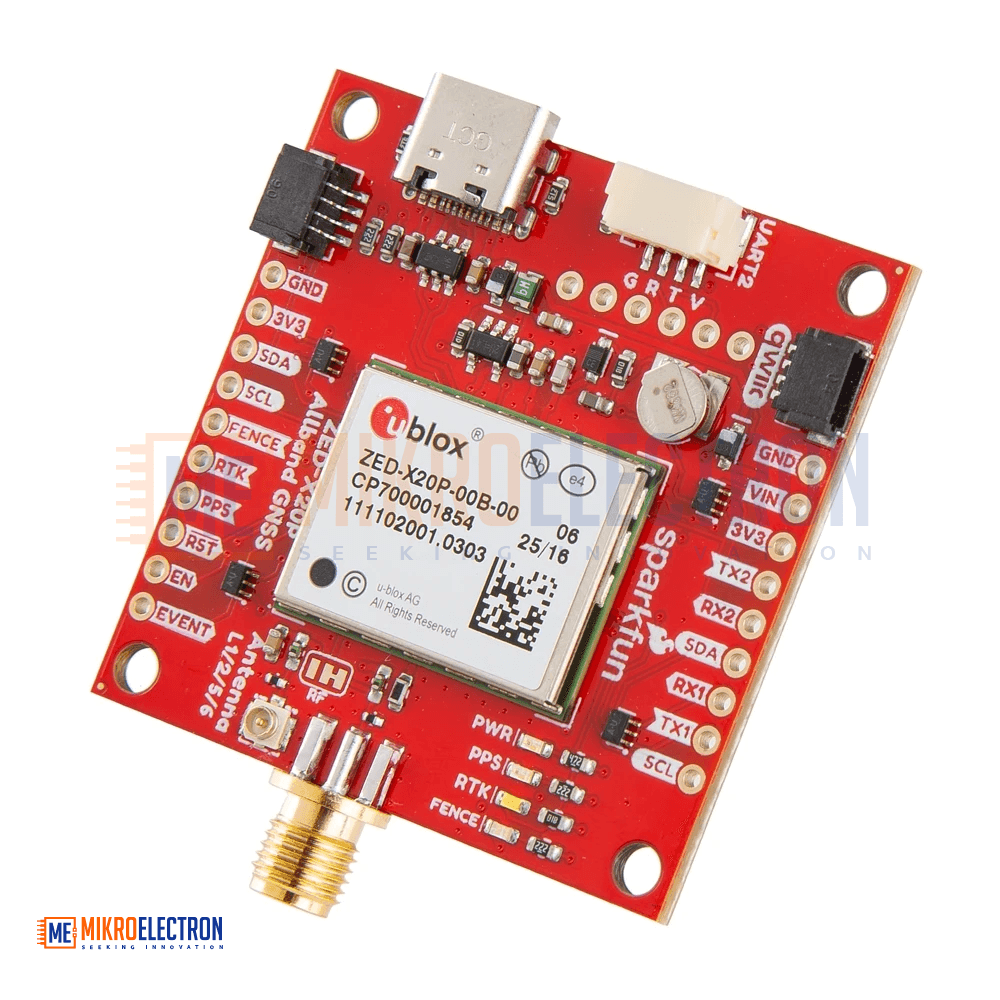
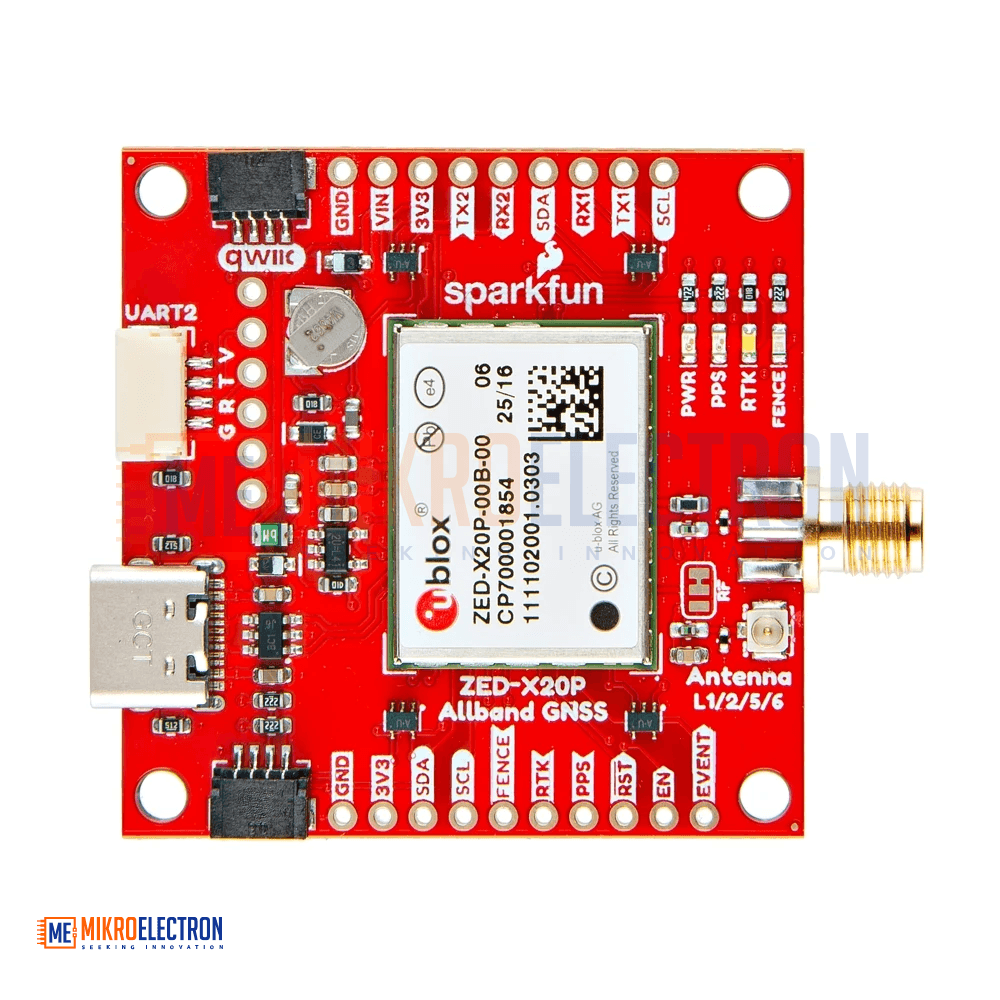
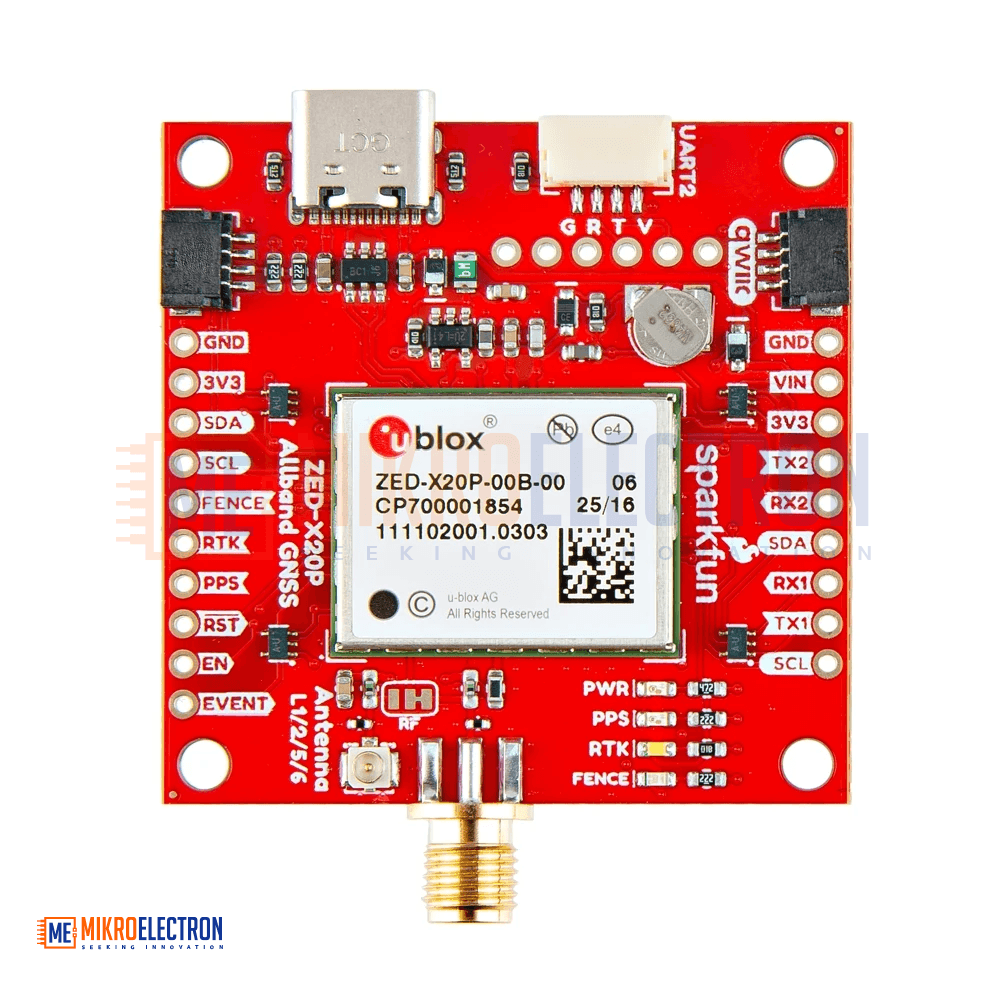
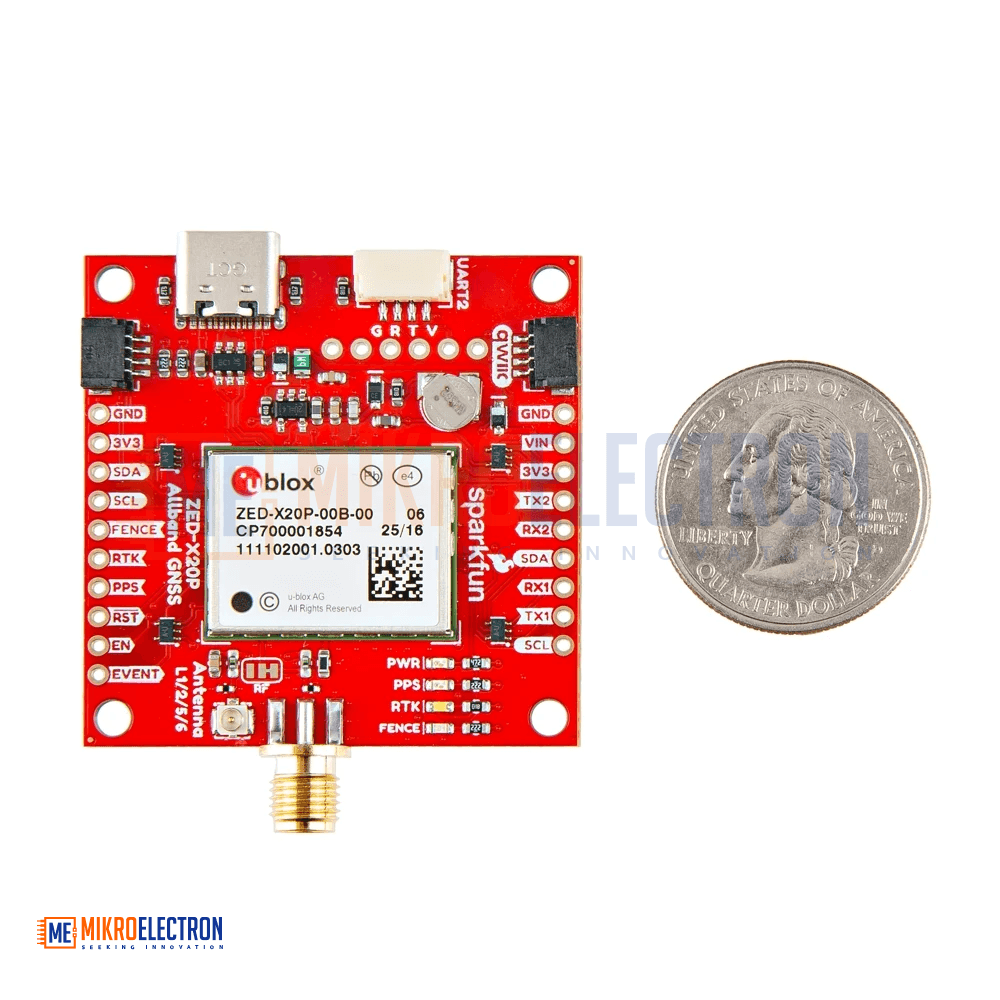
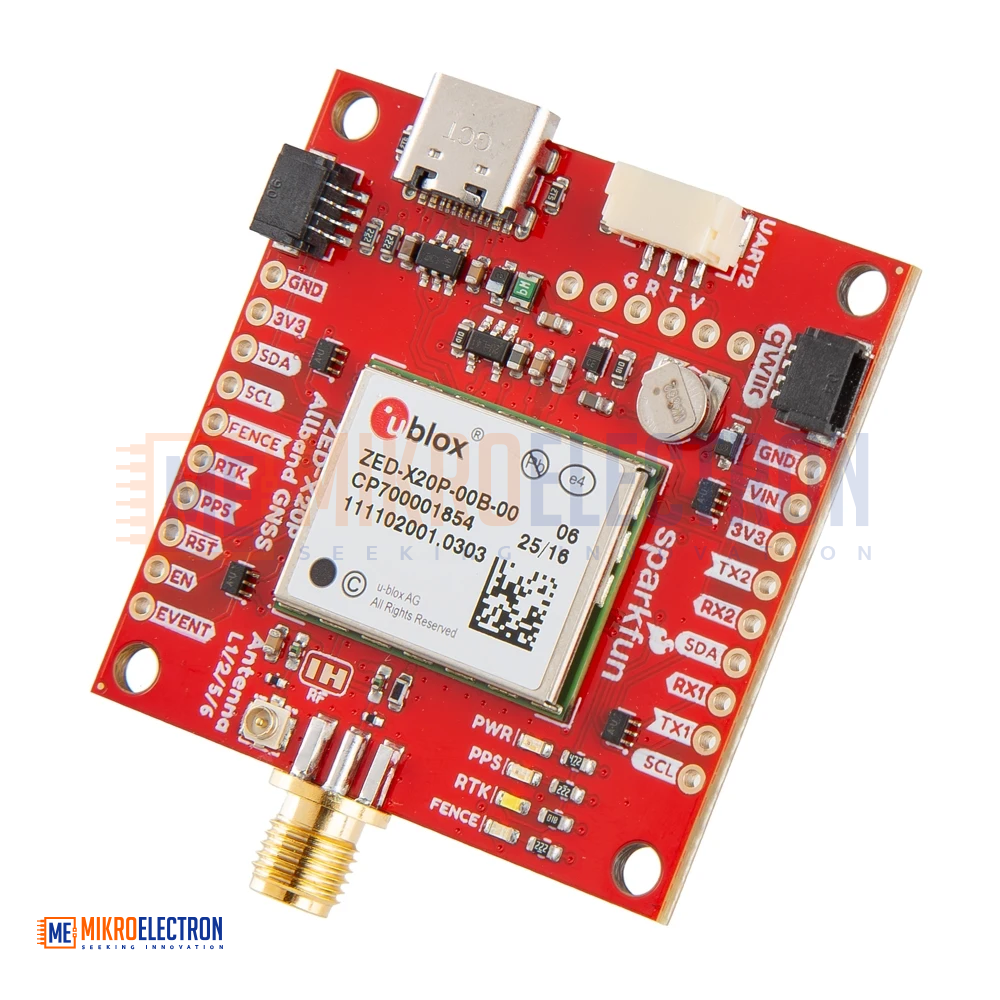
The SparkFun Allband GNSS RTK Breakout - ZED-X20P (Qwiic) features the latest GNSS engine from u-blox — the X20, which is the successor to their widely deployed F9 engine. The board's dimensions, pin layout, and connectors are very similar to the SparkFun GPS-RTK-SMA Breakout - ZED-F9P (Qwiic), and in most circumstances it can be used as a drop-in replacement, allowing existing enclosures, harnesses, and mounting designs to carry straight over to the new platform.
All-band, five-constellation reception. The ZED-X20P-01B is an all-band, high-precision GNSS receiver that concurrently processes signals from the GPS, Galileo, BeiDou, QZSS, and NavIC constellations across all GNSS frequency bands, including L-band. Rather than being limited to two or four bands, all-band reception maximizes the number of usable signals at any moment, which sharply improves ionospheric error modelling, multipath rejection, and availability under partial sky obstruction such as urban canyons and tree cover.
Multiple correction technologies. The module includes positioning algorithms for Real-Time Kinematics (RTK), PPP-RTK, and Precise Point Positioning (PPP). It supports standard RTCM corrections for Virtual Reference Stations (VRS) in a Network RTK setup or a local base station deployment. Critically, L-band correction services are natively supported without the need to integrate a separate receiver such as the NEO-D9S, reducing bill-of-materials cost, board space, and integration effort. Services including AssistNow and PointPerfect are supported, along with Galileo HAS and carrier phase output for post-processing workflows.
Built for control applications. With its exceptionally high update rate, the ZED-X20P is ideal for closed-loop control applications, ensuring smooth and reliable operation in auto-steering and robotics where position latency directly affects control stability.
Security and integrity. The module protects system integrity with multi-layered defenses, including a hardware Root of Trust, secure boot, jamming and spoofing detection, and cryptographic authentication of navigation messages through Galileo OSNMA. This represents the highest level of integration in a single-chip receiver for the navigation and robotics markets, unmanned autonomous vehicles (UAVs), guidance systems, and auto-steering applications.
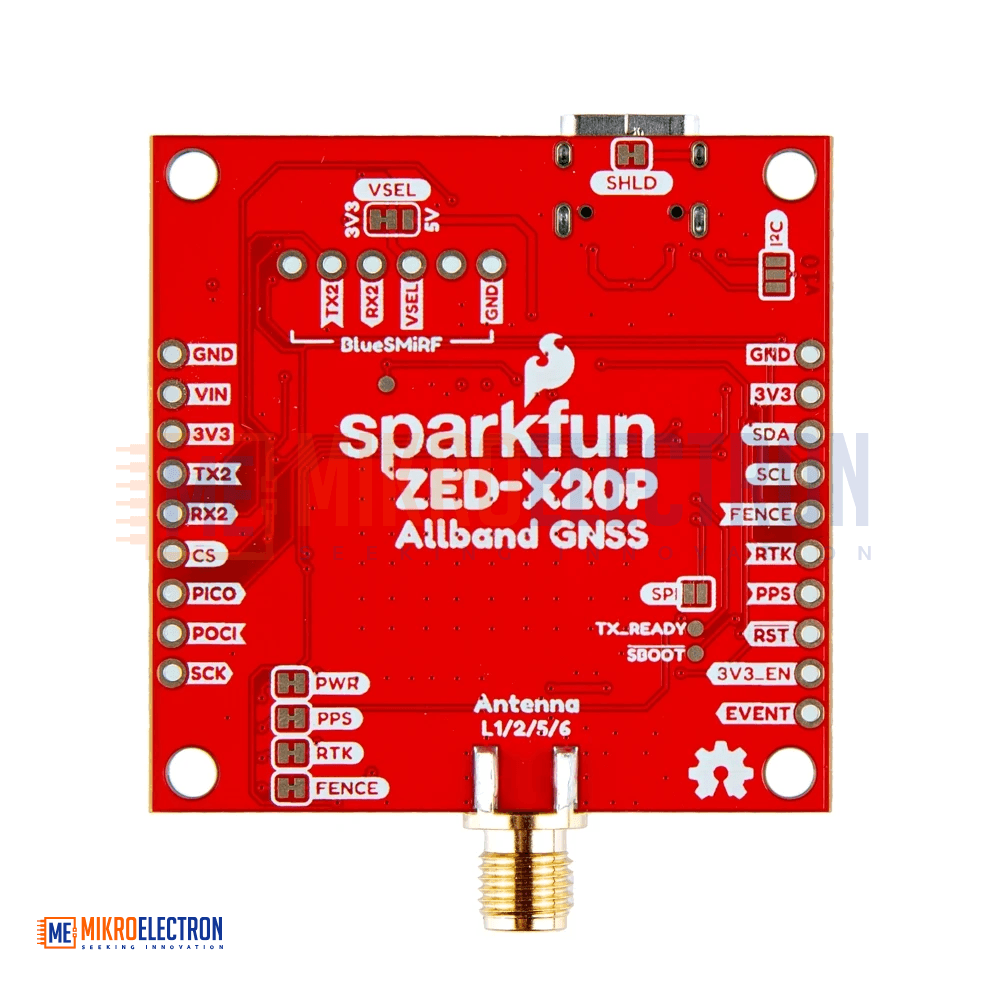
Connectivity and indicators. The breakout provides 19 PTH pins, two 4-pin Qwiic JST connectors, and three UART interfaces broken out to a USB-C connector, a 4-pin locking JST connector, and a 6-pin BlueSMiRF header for wireless correction radios, plus SPI and I2C interfaces. Four status LEDs give immediate feedback: red PWR, yellow PPS, white RTK, and blue FENCE for geofence status. An onboard backup battery preserves configuration and ephemeris data for fast warm starts, and four 4-40 compatible mounting holes allow secure mechanical installation.
Specifications
| Parameter | Specification |
|---|---|
| GNSS Module | u-blox ZED-X20P-01B all-band high-precision GNSS |
| GNSS Engine | u-blox X20 (successor to F9) |
| Constellations | GPS, Galileo, BDS (BeiDou), QZSS, NavIC |
| GPS Signals | L1C/A, L2C, L5 |
| Galileo Signals | E1-B/C, E5a, E6 |
| BeiDou Signals | B1I, B1C, B2a, B3I |
| QZSS Signals | L1C/A, L1C/B, L2C, L5 |
| NavIC Signals | L1-SPS Data, L5-SPS |
| SBAS Signals | L1C/A |
| SBAS Systems | WAAS, EGNOS, BDSBAS, MSAS, GAGAN |
| Positioning Technologies | RTK, PPP-RTK, PPP |
| Correction Support | RTCM (Network RTK / VRS or local base), native L-band |
| Supported Services | AssistNow, PointPerfect, Galileo HAS |
| Security Features | Root of Trust, Secure boot, Jamming & spoofing detection, Galileo OSNMA |
| Additional Features | Programmable flash memory, Carrier phase output |
| Module Interfaces | UART x2, SPI, I2C |
| Board Connections | 19 PTH pins, 2x Qwiic JST, USB-C, 4-pin locking JST, 6-pin BlueSMiRF header |
| Board UART Interfaces | 3x (USB-C, 6-pin BlueSMiRF header, 4-pin locking JST) |
| Supply Voltage | 2.7 V to 3.6 V |
| LEDs | PWR (red), PPS (yellow), RTK (white), FENCE (blue) |
| Backup Battery | Onboard, for fast warm start |
| Mounting Holes | 4x, 4-40 screw compatible |
| Operating Temperature | -40°C to +85°C |
| Module Dimensions | 17.0mm x 22.0mm x 2.4mm |
| Board Dimensions | 1.70" x 1.70" (43.2mm x 43.2mm) |
* Feature in development.
Applications
- Autonomous navigation for unmanned ground and aerial vehicles
- UAV and drone positioning, precision landing, and aerial survey
- Auto-steering and guidance systems for agricultural machinery
- Robotics platforms requiring high update rates for closed-loop control
- Precision agriculture – planting, spraying, and field boundary mapping
- Land surveying, GIS, and geodetic data collection
- Network RTK (VRS) rover applications over NTRIP
- Local base station deployment broadcasting RTCM corrections
- PPP and PPP-RTK applications using native L-band correction services
- Construction machine control and site layout
- Security-critical positioning requiring OSNMA authentication and spoofing detection
- Structural and geodetic monitoring using carrier phase output
- Drop-in upgrade for existing systems built around the ZED-F9P Qwiic breakout