
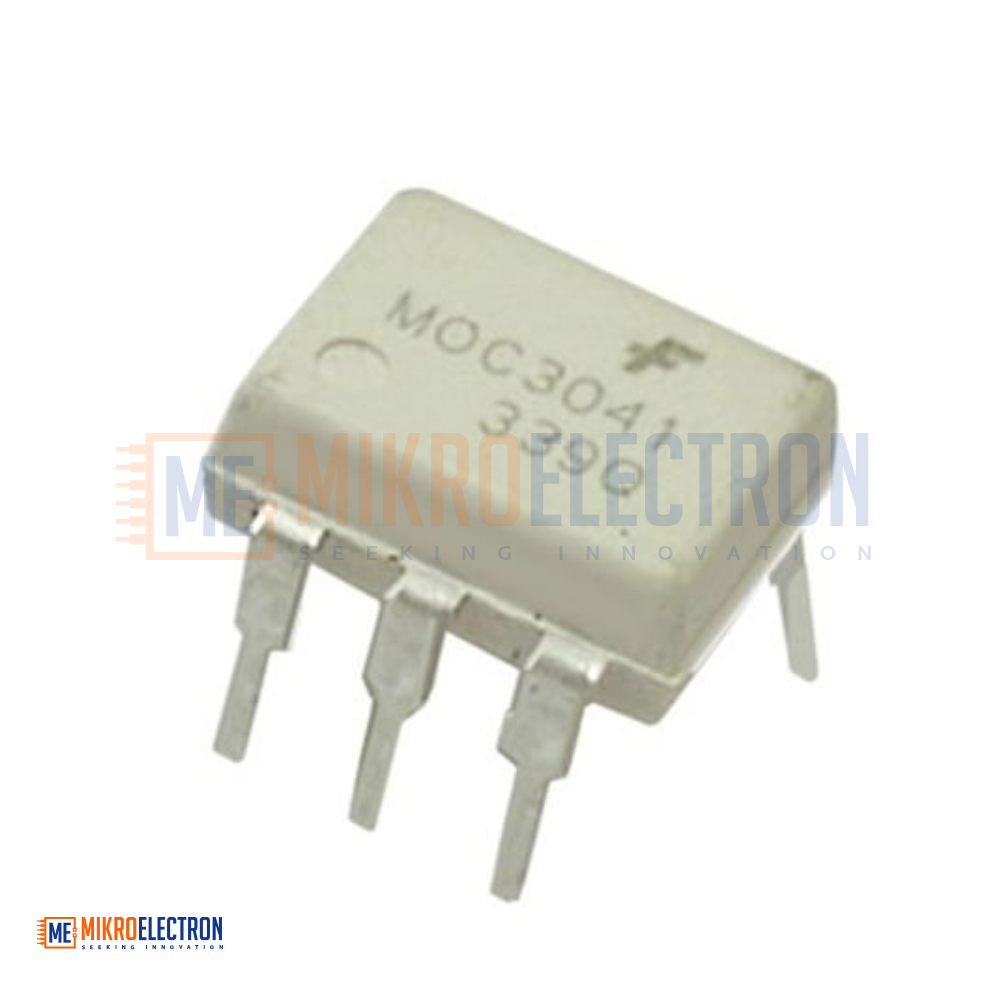
MOC3041 TRIAC DRIVER
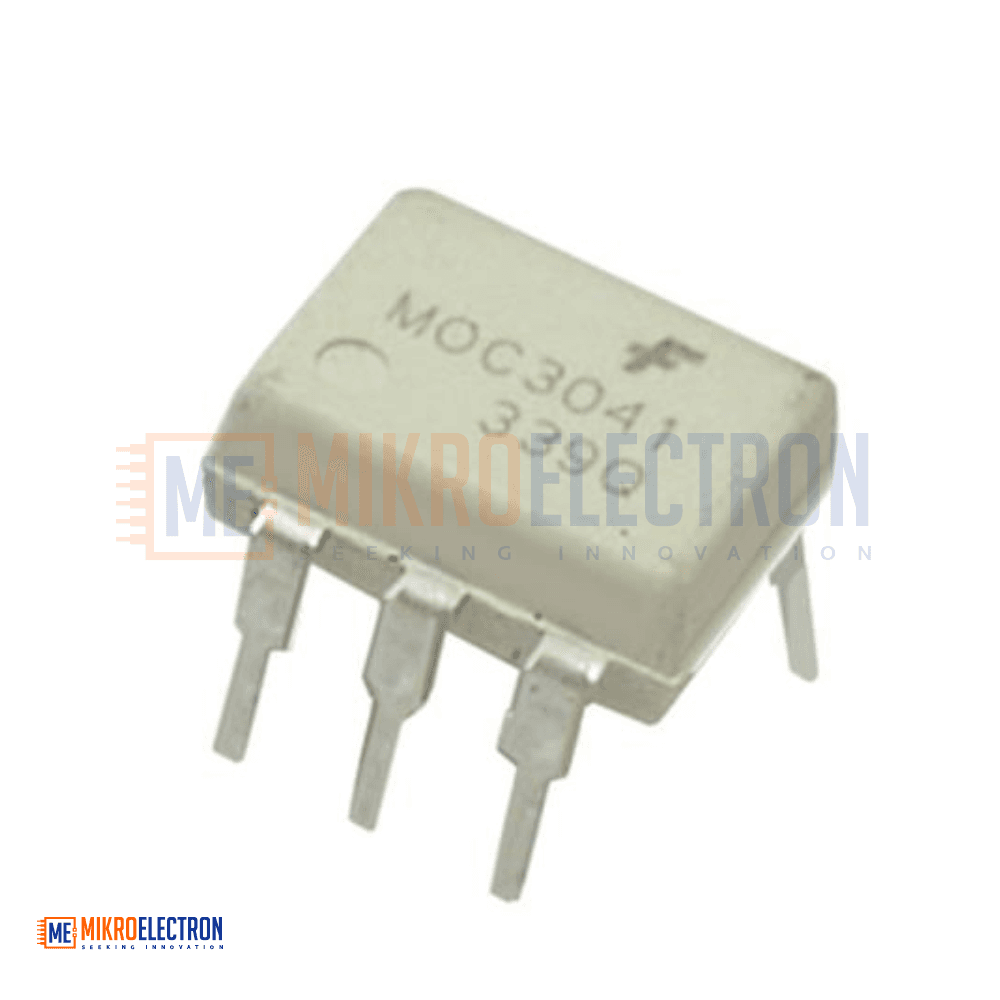
The MOC3041 is a 6-pin DIP optocoupler with built-in zero-crossing TRIAC driver, designed to safely interface microcontrollers (Arduino, ESP32, PIC) with high-voltage AC loads. With 7500V isolation voltage, 400V output capability, and a trigger current of just 15mA, it provides reliable galvanic isolation between low-voltage logic and AC mains. Combined with a power TRIAC like the BT139, the MOC3041 is ideal for AC light dimmers, motor controllers, heater regulators, and smart home automation projects.
المُعزل الضوئي MOC3041 هو مُحرّك ترياك بـ 6 أرجل DIP مدمج فيه مُكتشف عبور الصفر، مصمم لربط المتحكمات الدقيقة (Arduino و ESP32 و PIC) بأمان مع أحمال التيار المتناوب عالية الجهد. يتميز بـ عزل كهربائي 7500 فولت، وجهد خرج يصل إلى 400 فولت، وتيار تشغيل لا يتجاوز 15 مللي أمبير، مما يوفر عزلاً موثوقاً بين منطق الجهد المنخفض وتيار الشبكة المتناوب. عند دمجه مع ترياك قوة مثل BT139، يُعدّ مثالياً لـ مخفتات الإضاءة، ومتحكمات المحركات، ومنظمات السخانات، ومشاريع المنازل الذكية.
The MOC3041 is a high-performance optocoupler/photo-TRIAC driver IC that combines an infrared LED with a silicon photo-TRIAC in a single 6-pin DIP package. Its key feature is the integrated zero-crossing detection circuit, which ensures that the output TRIAC is only triggered at the zero-crossing point of the AC waveform — significantly reducing electrical noise (EMI/RFI), inrush currents, and switching transients in AC power-control applications.
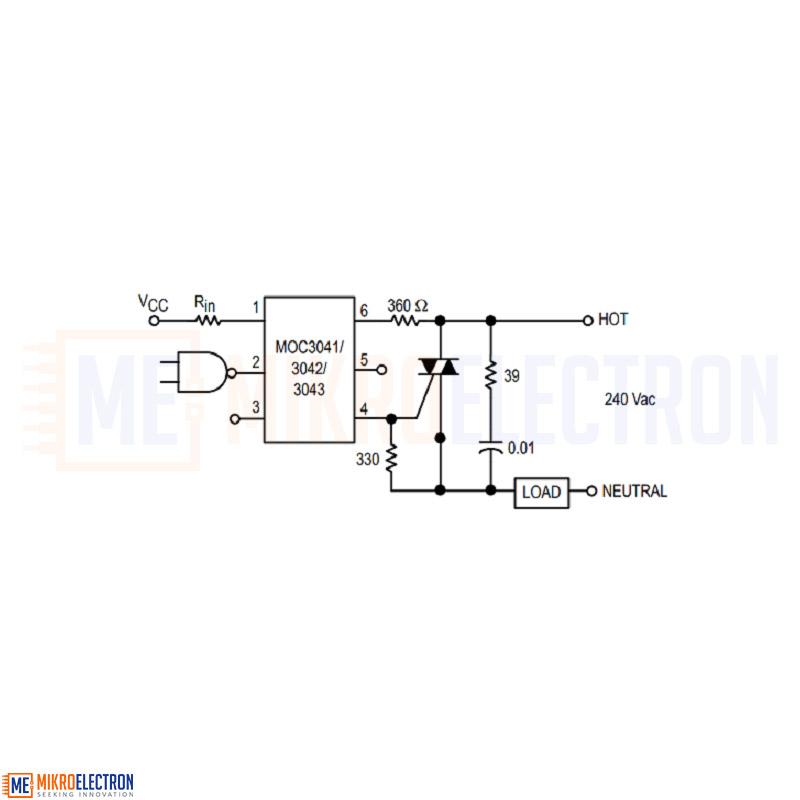
The MOC3041 provides galvanic isolation up to 7500V between the low-voltage control side (microcontroller) and the high-voltage AC load side, making it the safest and most reliable way to control AC mains from digital electronics. The infrared LED on the input side can be driven by a simple current-limiting resistor and a microcontroller pin (typically through a 220Ω–470Ω resistor), while the photo-TRIAC output is connected to the gate of a power TRIAC like the BT139, BTA12, or BTA16.
Because of its zero-crossing feature, the MOC3041 is ideal for on/off control of resistive loads such as heaters, incandescent lamps, and solenoids — providing clean, glitch-free switching with minimal interference. For phase-angle control (required for dimming and motor speed control), the non-zero-crossing variant MOC3021 should be used instead.
Housed in a standard DIP-6 package, the MOC3041 is easy to mount on PCBs, breadboards, or in IC sockets. It is widely used in commercial AC dimmer modules, smart relays, IoT switches, and industrial control systems.
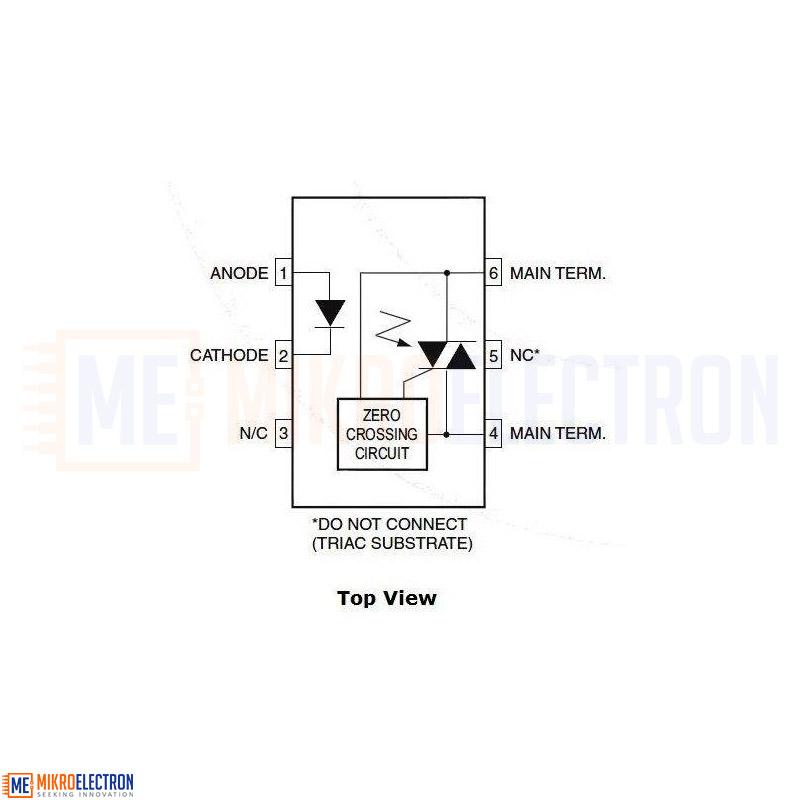
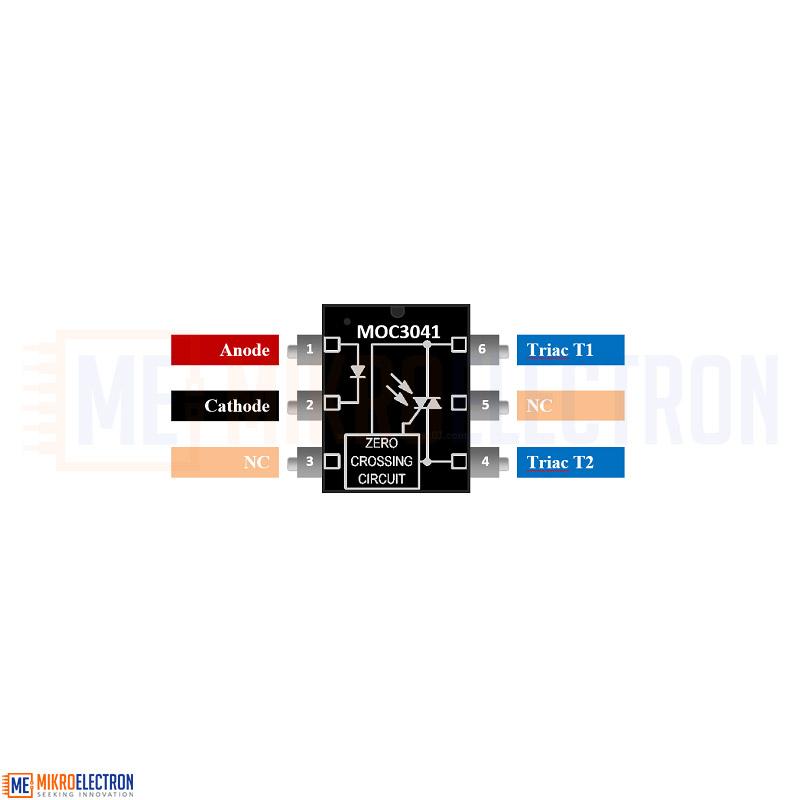
Pinout (DIP-6)
- Pin 1: Anode (LED Input +)
- Pin 2: Cathode (LED Input -)
- Pin 3: No Connection (NC)
- Pin 4: Main Terminal 1 (MT1) – Output
- Pin 5: Substrate (NC)
- Pin 6: Main Terminal 2 (MT2) – Output
Specifications
- Part Number: MOC3041
- Type: Optocoupler with Zero-Crossing Photo-TRIAC Driver
- Number of Channels: 1
- Package: DIP-6 (6-pin Dual In-line Package)
- Isolation Voltage: 7500 V (RMS)
- Output Voltage (V_DRM): 400 V (peak repetitive off-state voltage)
- LED Forward Current (I_F): 60 mA (max), 15 mA (typical trigger)
- LED Forward Voltage (V_F): ~1.3 V (typical)
- Trigger Current (I_FT): 15 mA (max)
- Output On-State Current: 1 A (peak), 100 mA (continuous)
- Holding Current (I_H): ~250 µA
- Inhibit Voltage (V_IH): ~5 V (zero-crossing window)
- Operating Temperature: -40°C to +85°C
- Storage Temperature: -40°C to +150°C
- Zero-Crossing Detection: Yes (Built-in)
- Compliance: RoHS Compliant
Applications
- AC Solid-State Relays — silent, fast switching of mains-powered loads
- Smart Home AC Switches — WiFi-controlled relays via ESP32/ESP8266
- Heater Power Control — clean ON/OFF control of heating elements
- Incandescent Lamp Switching — flicker-free zero-cross switching
- Solenoid AC Switching — electric valves and locks on mains voltage
- Microcontroller-to-AC Mains Interface — galvanically isolated control
- Home Automation Systems — automated appliance control
- Industrial AC Switching — clean control of motors, fans, and heaters
- Static AC Switching Circuits — alternative to mechanical relays
- Temperature Controllers — paired with thermostats and PID controllers
- PLC Output Stages — interfacing PLC outputs with AC loads
- DIY Arduino AC Control Projects — combining with BT139 for full power control
- Educational & STEM Electronics — teaching optocoupler and TRIAC concepts
- Replacement / Upgrade — for relay-based AC switching systems
- Light Switches with Zero-Cross Switching — reduced EMI for sensitive electronics