
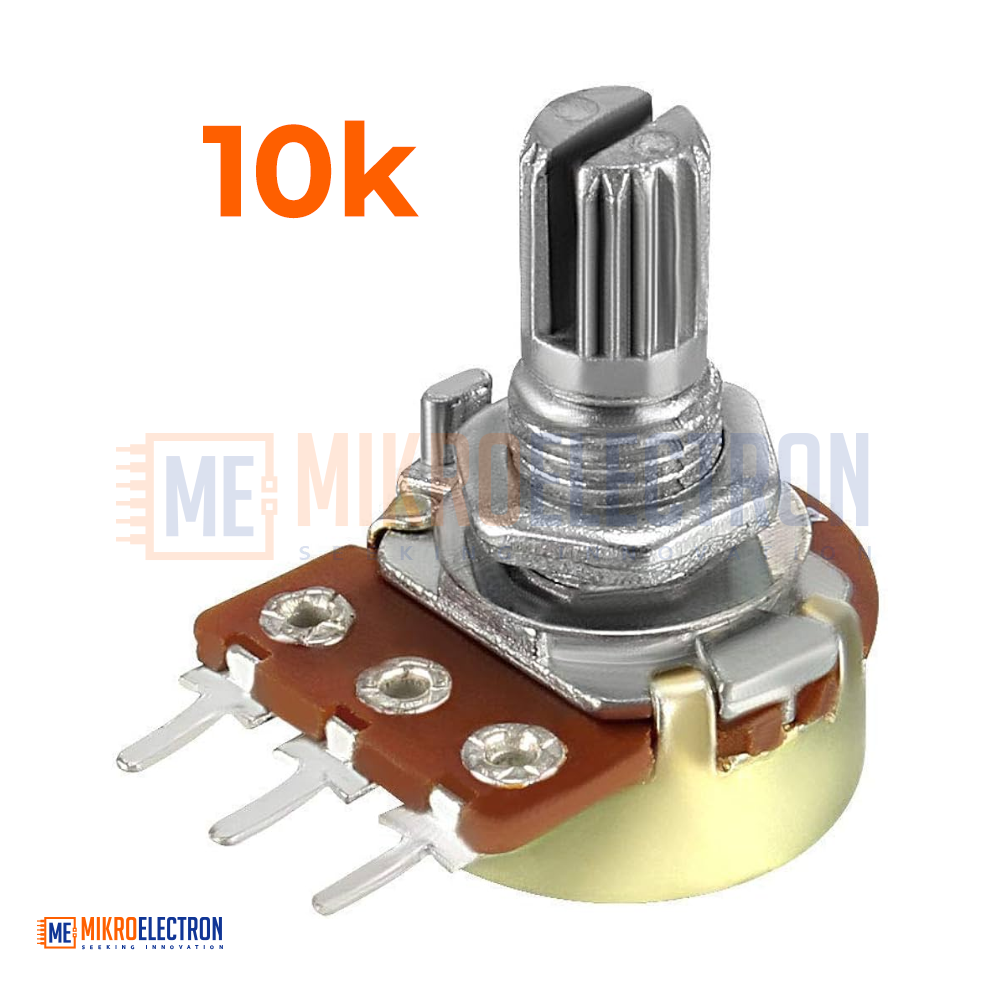
Potentiometer 10K
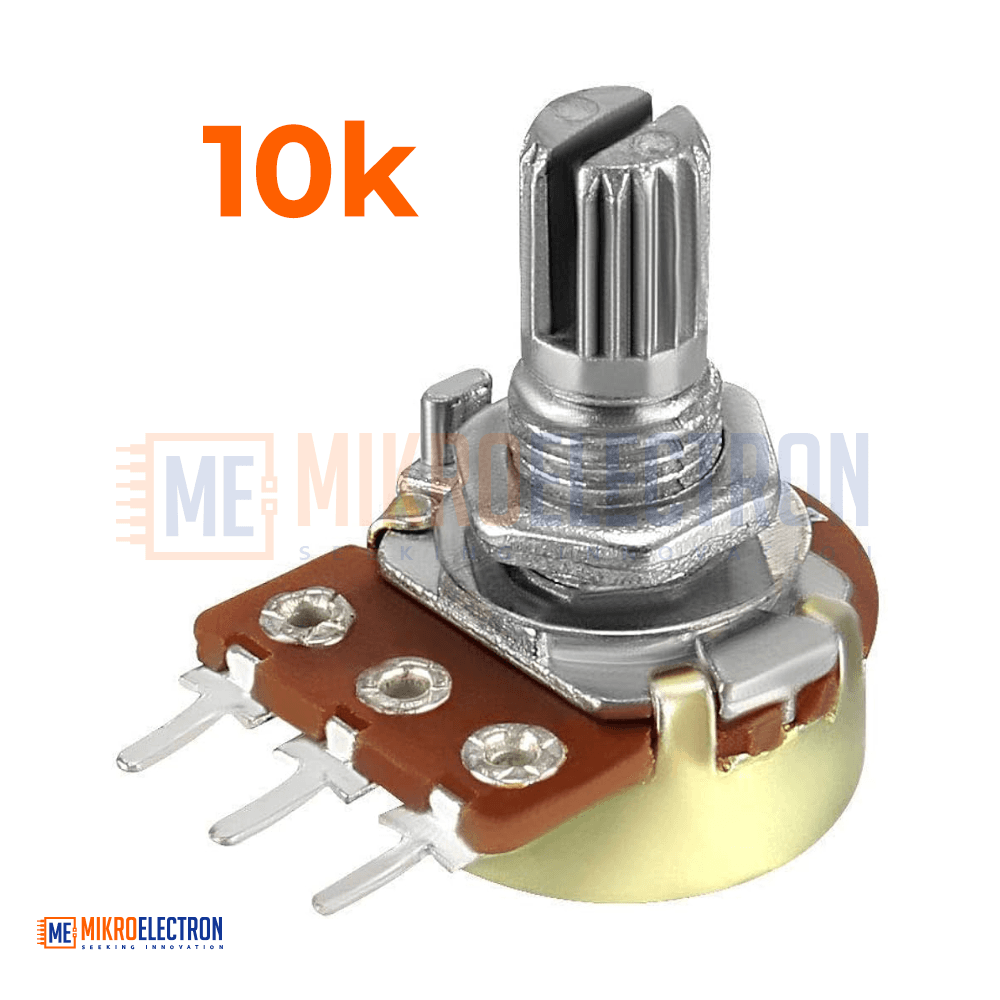
The 10kΩ Potentiometer is a versatile linear taper rotary potentiometer with a grippy shaft and breadboard-friendly 0.2" pin spacing, perfect for DIY electronics, Arduino projects, and panel-mounted designs. Its smooth yet stable rotation makes it easy to adjust without unintended shifting. With a two-in-one design suitable for both breadboard prototyping and panel mounting, it's ideal for volume controls, brightness adjustment, sensor calibration, and analog input in any electronic project.
المقاومة المتغيرة 10 كيلو أوم (Potentiometer) هي مقاومة دوّارة خطية متعددة الاستخدامات ذات مقبض ممسك بإحكام وأرجل بمسافة 0.2 إنش متوافقة مع لوحات التجارب، مثالية لـ مشاريع الإلكترونيات DIY ومشاريع Arduino والتصاميم المثبّتة على اللوحات. تتميز بحركة دوران سلسة وثابتة تسهل الضبط دون انزلاق غير مقصود. بفضل تصميمها المزدوج المناسب لكل من لوحات التجارب والتثبيت على لوحات التحكم، تُعدّ مثالية لـ التحكم بمستوى الصوت، وتعديل السطوع، ومعايرة الحساسات، والإدخال التناظري في أي مشروع إلكتروني.
The 10kΩ Potentiometer is a high-quality linear taper rotary potentiometer designed for both breadboard prototyping and panel-mounted installation — making it one of the most versatile potentiometers available for hobbyists, students, engineers, and DIY electronics enthusiasts. Its two-in-one design allows you to use the same component for rapid prototyping on a breadboard or perfboard, then transfer it directly to your project's enclosure panel without changing parts.
The 10 kilo-ohm (10kΩ) resistance value is one of the most common and useful potentiometer values in electronics. It pairs perfectly with microcontroller analog inputs (such as Arduino A0, ESP32 ADC pins, and Raspberry Pi Pico) to create adjustable user controls for volume, brightness, speed, threshold settings, and menu navigation. The linear taper ensures a proportional change in resistance with rotation, providing predictable and intuitive control behavior — ideal for parameter adjustment and calibration.
The potentiometer features a grippy plastic shaft that provides excellent finger grip for fine adjustment, with smooth yet firm rotation that prevents accidental shifts due to vibration or movement. The shaft is shaped to accept standard knobs for a polished, professional appearance in finished projects.
What makes this potentiometer truly special is its 0.2" (5.08mm) pin-point spacing, which is breadboard- and perfboard-friendly. The three pins are arranged so you can plug the potentiometer directly into a breadboard for testing, then transfer it to a panel mount by drilling a hole in your project enclosure and securing it with the included nut and washer. This eliminates the need to buy two different potentiometers (one for prototyping, one for the final build) and saves both time and cost.
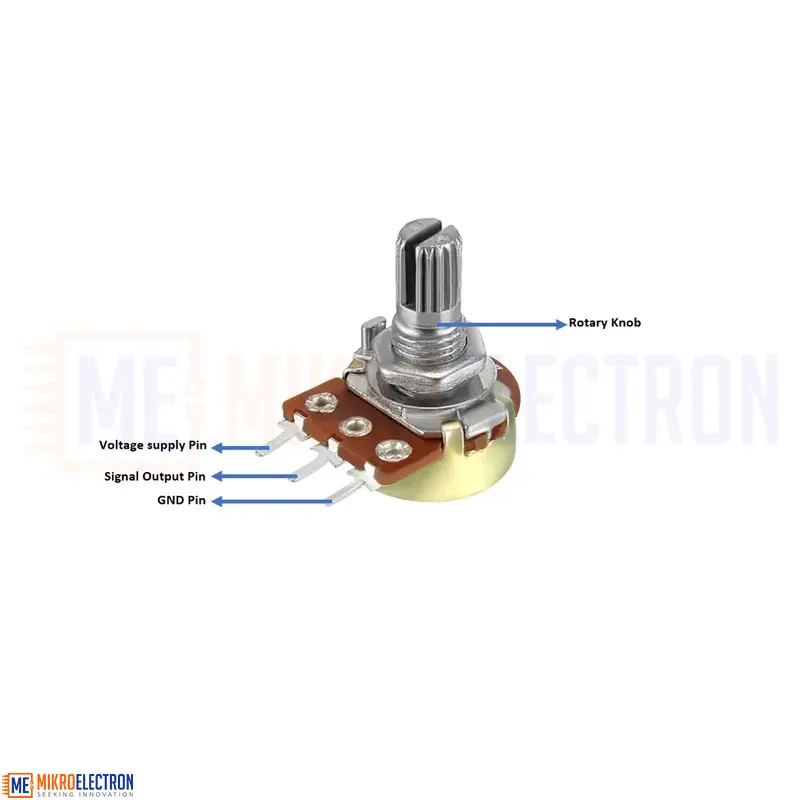
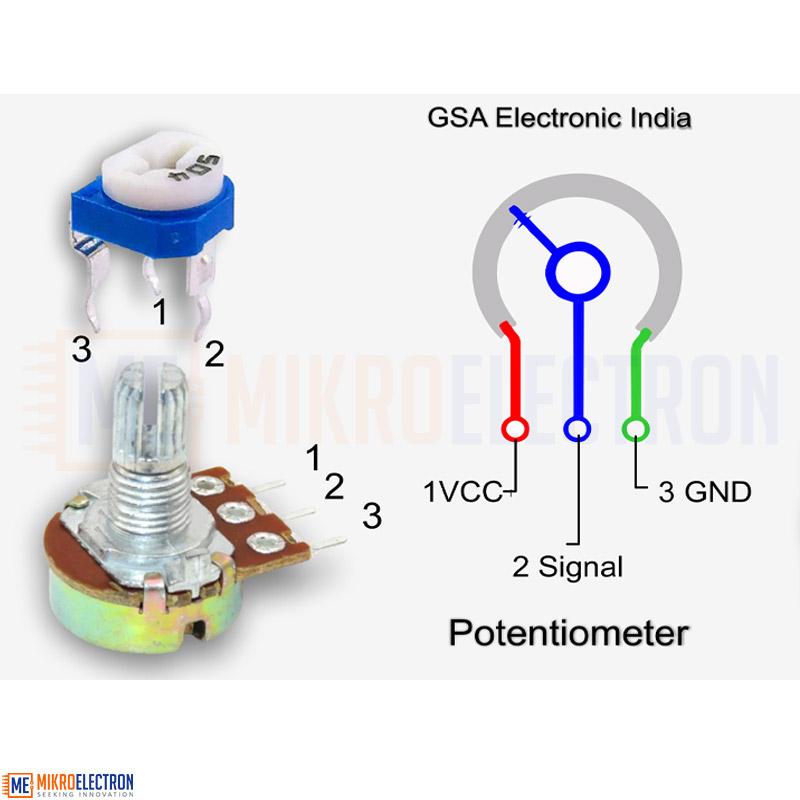
The 3 terminal connections follow the standard potentiometer convention:
- Two outer pins connect to the fixed ends of the resistive element (e.g., VCC and GND)
- The center pin (wiper) connects to the moving contact that slides along the resistive track, providing a variable voltage output proportional to the shaft position
This makes the potentiometer perfect for use as a voltage divider, variable resistor (rheostat), or adjustable input in countless circuit designs.
How It Works
A potentiometer is a three-terminal variable resistor. As you rotate the shaft:
- The wiper (center pin) moves along the resistive track between the two outer pins
- The resistance between the wiper and either end changes proportionally
- When connected as a voltage divider (with VCC on one end pin and GND on the other), the wiper outputs a voltage that varies from 0V to VCC depending on rotation
- This voltage can be read by a microcontroller's ADC to detect the user's input position
Specifications
- Resistance Value: 10 kΩ (10,000 Ohm)
- Taper: Linear (Type B)
- Type: Rotary Potentiometer (3-Terminal)
- Pin Spacing: 0.2 inch (5.08 mm) — Breadboard Friendly
- Number of Terminals: 3 (Two ends + Wiper)
- Mounting Style: Dual — Through-hole / breadboard + Panel-mount with nut
- Shaft Type: Grippy plastic shaft
- Rotation Angle: Typically ~270° (single-turn)
- Tolerance: Typically ±20% (standard for potentiometers)
- Power Rating: Typically 0.25W
- Operating Temperature: Typically -10°C to +70°C
- Compliance: RoHS Compliant
Pinout
- Pin 1 (Left End): Connected to one end of the resistive track (e.g., GND)
- Pin 2 (Center / Wiper): Variable output — moves along the track with rotation
- Pin 3 (Right End): Connected to the other end of the resistive track (e.g., VCC)
Applications
- Volume Controls — audio amplifier and speaker volume adjustment
- Brightness Controls — LED dimming and display brightness adjustment
- Speed Controls — DC motor speed adjustment via PWM
- Sensor Calibration — fine-tuning sensor thresholds and offsets
- Arduino Analog Inputs — user adjustable parameters via analogRead()
- Threshold Adjustment — comparator and trigger level setting
- Menu Navigation — scrolling through LCD/OLED menu items
- DIY Audio Equipment — guitar pedal controls, mixer faders
- Servo Motor Position Control — manual servo angle adjustment
- Variable Power Supplies — adjusting output voltage
- Robot Control Panels — manual operator inputs
- 3D Printer Controls — temperature, speed, and flow adjustment
- Educational & STEM Projects — teaching analog electronics concepts
- Game Controllers — joystick and paddle controllers
- Lighting Effect Controllers — color, speed, and pattern adjustment
- Function Generators — frequency and amplitude controls
- Audio Mixing Consoles — channel and effect controls
- Camera Sliders & Gimbals — speed and direction controls
- DIY Synthesizers & MIDI Controllers — knobs for parameter control
- Replacement Component — for damaged 10kΩ potentiometers in equipment