
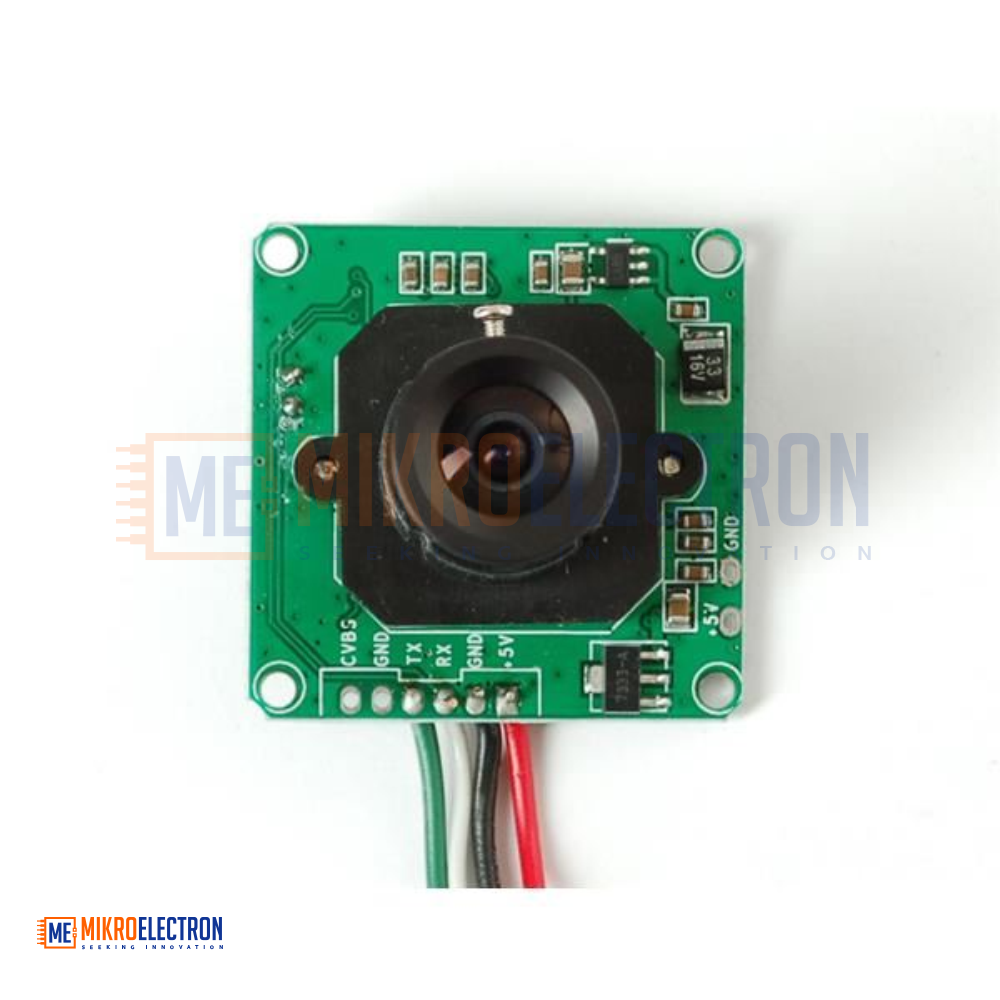
TTL Serial JPEG Camera with NTSC Video
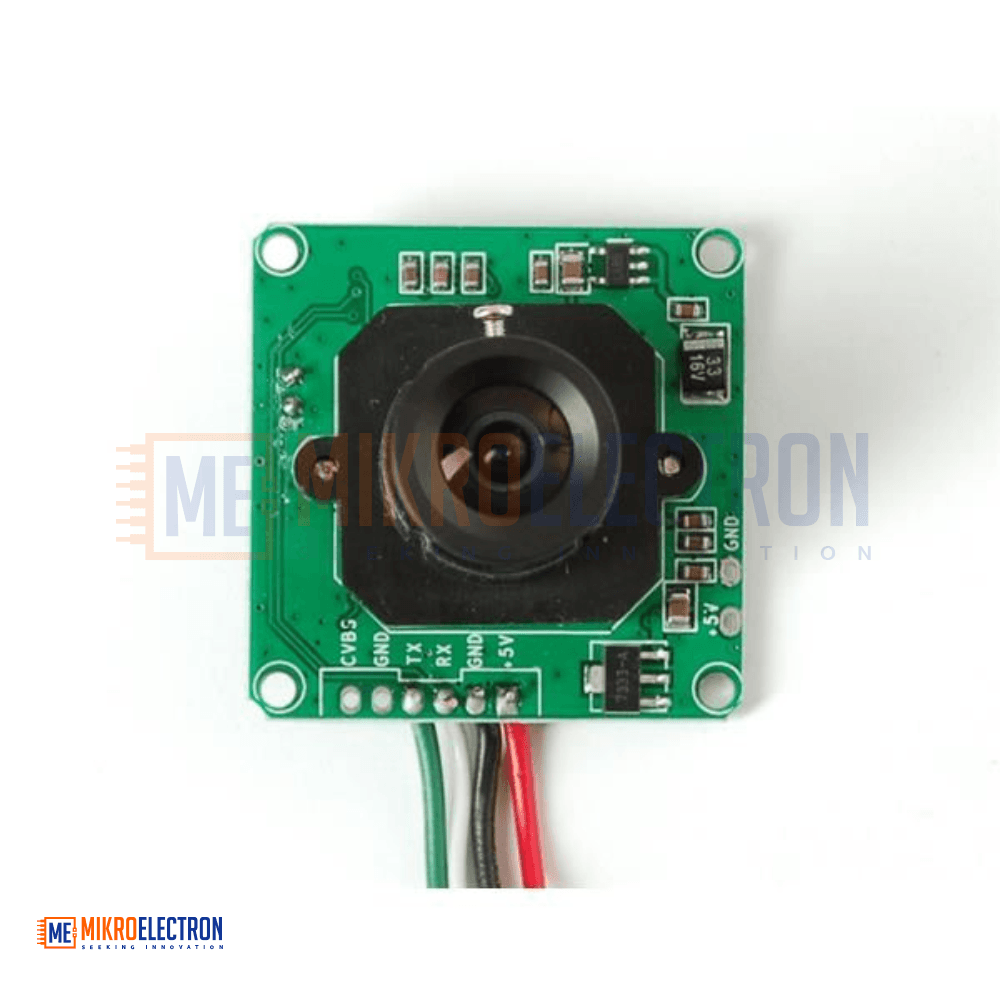
The TTL Serial JPEG Camera with NTSC Video is a versatile CMOS camera module that outputs NTSC monochrome video and captures color JPEG snapshots via 3.3V TTL serial. Supporting resolutions of 640x480, 320x240, and 160x120, it features manual focus, auto white balance, auto exposure, and built-in motion detection. Perfect for Arduino, ESP32, security cameras, data-logging, time-lapse, and photography projects — with a dedicated Arduino library for easy integration.
كاميرا JPEG التسلسلية TTL مع فيديو NTSC هي مودول كاميرا CMOS متعدد الاستخدامات يوفر فيديو NTSC أحادي اللون ويلتقط صور JPEG ملونة عبر منفذ تسلسلي TTL 3.3 فولت. يدعم دقات 640×480 و320×240 و160×120، ويتميز بـ بؤرة قابلة للضبط، توازن أبيض تلقائي، تعرض تلقائي، وكاشف حركة مدمج. مثالي لـ الأردوينو وESP32، كاميرات المراقبة، تسجيل البيانات، التصوير الزمني، ومشاريع التصوير — مع مكتبة أردوينو جاهزة للتكامل السهل.
The TTL Serial JPEG Camera with NTSC Video Output is a powerful and feature-rich CMOS camera module designed for embedded electronics, security systems, and DIY photography projects. Combining dual functionality in a single compact board, it can simultaneously output a live NTSC monochrome video stream for use with traditional analog displays or video receivers, and capture high-quality color JPEG snapshots that can be transmitted to a microcontroller over a simple 3.3V TTL serial connection.
The module captures images at three selectable resolutions: 640x480 (VGA), 320x240 (QVGA), and 160x120 (QQVGA). All snapshots are pre-compressed in standard JPEG format by the onboard DSP, dramatically reducing file size and making it easy to store images on SD cards, transmit them wirelessly, or upload them to a server. This onboard compression also offloads heavy image processing from your microcontroller, allowing even modest boards like the Arduino Uno to handle image capture comfortably.
The camera is packed with smart features that make it stand out from basic camera modules. It supports manually adjustable focus, automatic white balance, automatic brightness and contrast adjustment, and automatic exposure / gain control — meaning you don't have to manage image quality settings manually for changing lighting conditions. Even more impressively, the module has built-in motion detection, allowing it to send a signal when movement is detected within the frame. This makes it ideal for alarm systems, wildlife cameras, smart doorbells, and event-triggered photography.
Using the camera is refreshingly simple. With just two digital pins (TX and RX) or a hardware UART, your microcontroller can communicate with the module at the default 38400 baud rate (configurable up to 115200 baud). A dedicated Arduino library with example code is widely available, providing ready-made functions to change image size, set compression quality, capture snapshots, detect motion, and control the video output stream.
The CMOS sensor offers a 1/4-inch image area, 5.6µm pixel size, 45dB SNR, 60dB dynamic range, and a 60° viewing angle, with a typical monitoring distance of up to 10–15 meters when paired with proper optics and lighting. The camera operates from a single 5V supply with a low 75mA current draw, making it suitable for both bench-top and battery-powered projects.
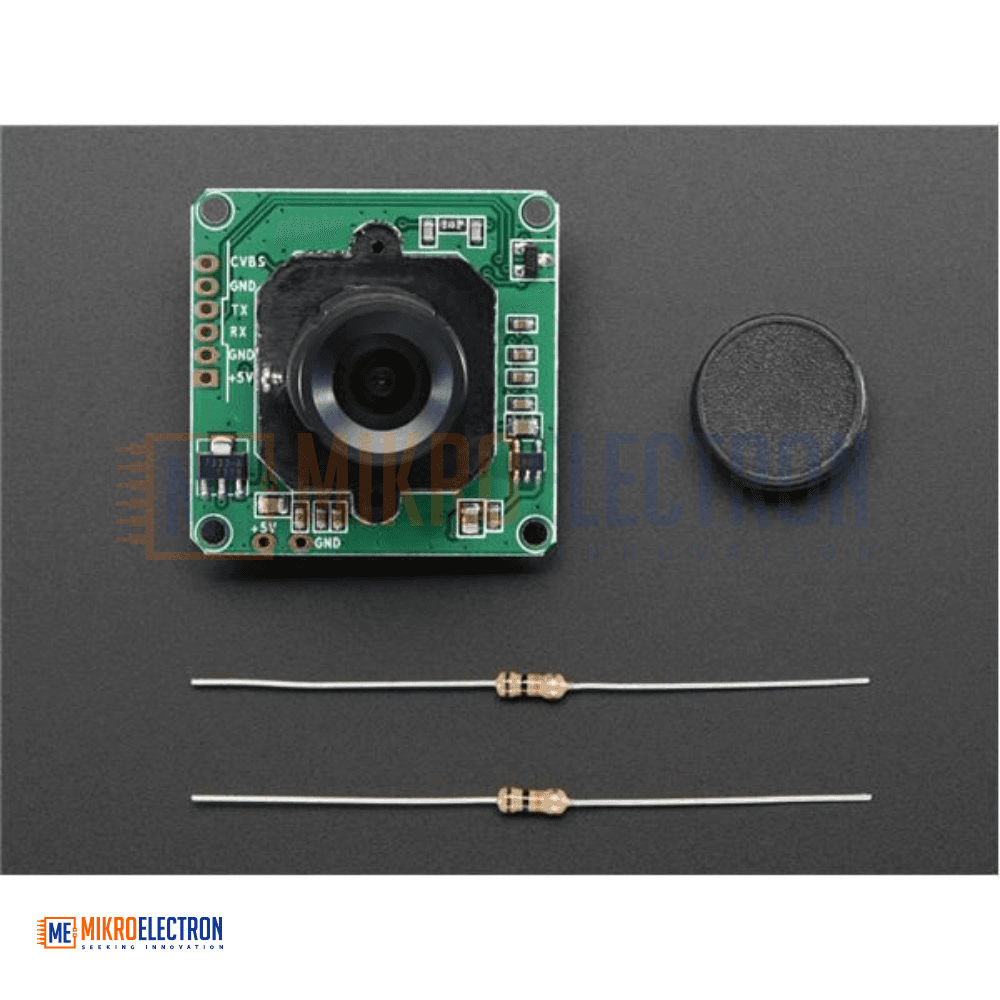
Communication Note: The module uses 3.3V TTL signaling. When using it with 5V Arduino boards (Uno, Mega, Nano), a logic level converter or a simple resistor voltage divider is recommended on the TX line going into the camera to prevent damage.
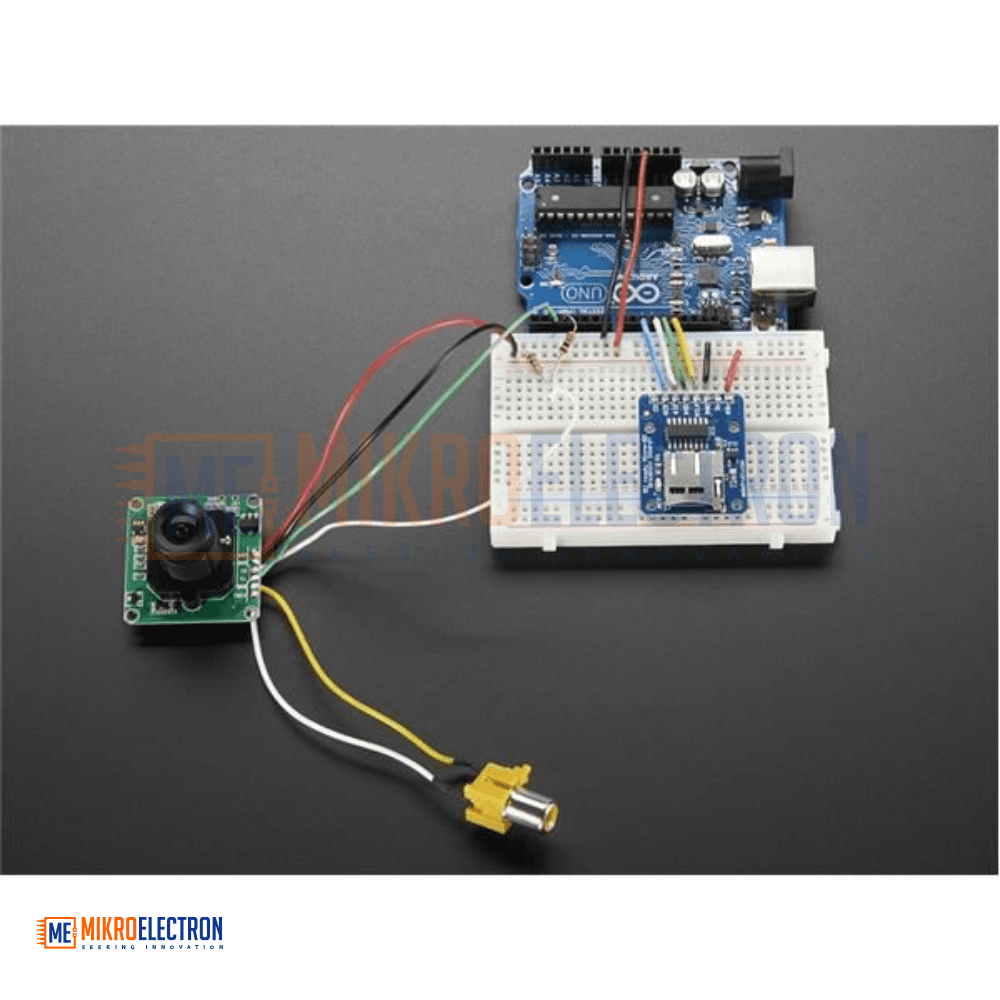
Wiring Guide (Typical with Arduino)
| Camera Pin | Connection |
|---|---|
| VCC | 5V |
| GND | GND |
| TX | Arduino RX (pin 2 if using SoftwareSerial) |
| RX | Arduino TX (pin 3 if using SoftwareSerial) — through level shifter |
| Video | NTSC composite output to TV/monitor (yellow RCA jack) |
Specifications
General
- Module Type: TTL Serial JPEG Camera with NTSC Video Output
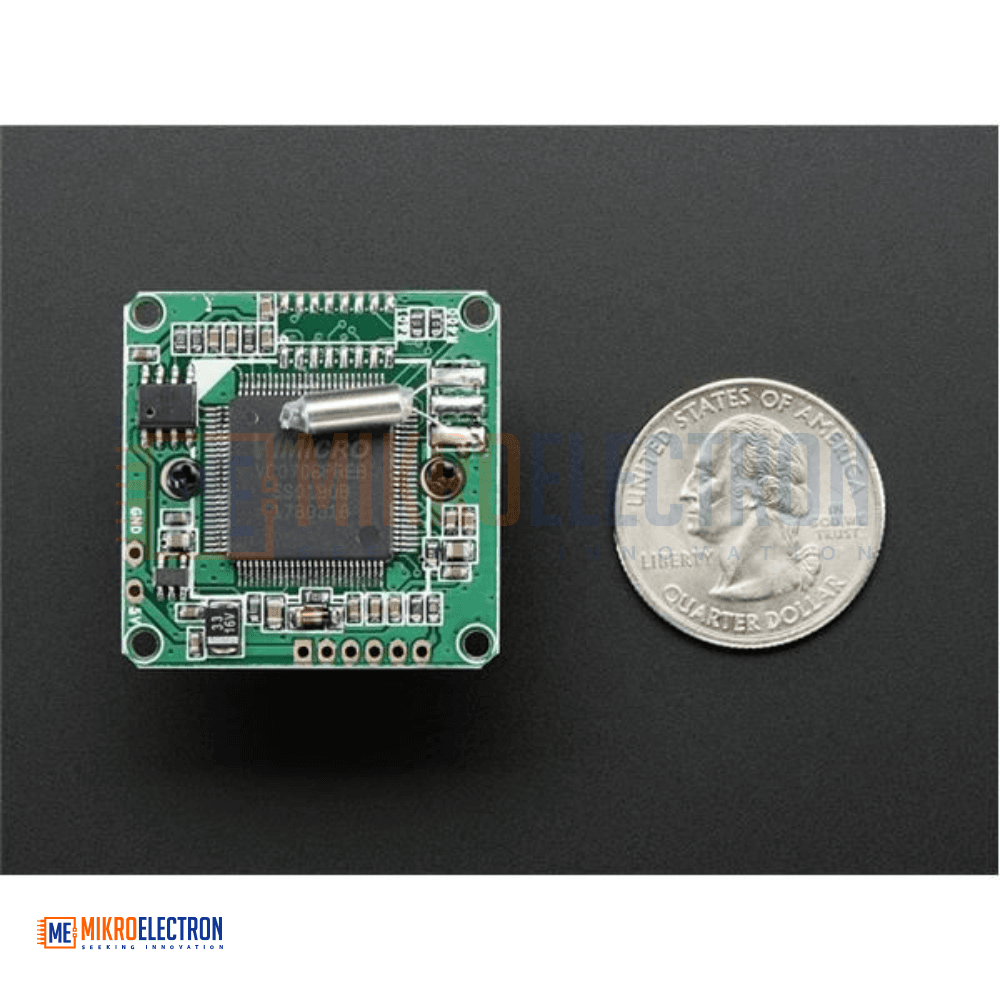
- Module Size: 32mm x 32mm
- Operating Voltage: DC 5V
- Operating Current: 75 mA
- Communication: 3.3V TTL Serial (3-wire: TX, RX, GND)
- Default Baud Rate: 38400 bps
- Maximum Baud Rate: 115200 bps
- Video Output: NTSC Monochrome (composite)
- Image Output Format: Standard JPEG (color)
Image Sensor
- Sensor Type: CMOS, 1/4 inch
- Total Pixels: 30M (30 megapixel array — see notes)
- Pixel Size: 5.6µm x 5.6µm
- Shutter Type: Electronic Rolling Shutter
- Scan Mode: Progressive scan
- SNR (Signal-to-Noise Ratio): 45 dB
- Dynamic Range: 60 dB
- Maximum Analog Gain: 16 dB
- Frame Speed: 30 fps @ 640x480
- Viewing Angle: 60°
- Monitoring Distance: Up to 10 meters (adjustable up to 15 meters)
Image Capture
- Resolutions Supported:
- VGA: 640 x 480
- QVGA: 320 x 240
- QQVGA: 160 x 120
- Compression: Standard JPEG (onboard)
- Quality: Adjustable compression quality
Image Processing Features
- Focus: Manually adjustable
- White Balance: Automatic
- Exposure: Automatic
- Gain Control: Automatic
- Brightness & Contrast: Automatic
- Motion Detection: Built-in
Applications
- Security and surveillance cameras — alarm-triggered photo capture
- Smart doorbells with snapshot storage
- Wildlife and trail cameras with motion-triggered shooting
- Time-lapse photography projects
- Data-logging systems with image evidence
- Robotics vision projects — capturing snapshots from robots
- Drones and RC vehicles — aerial snapshot or video downlink
- Smart mailbox cameras
- Industrial machine vision — quality control snapshots
- Educational STEM and university projects
- DIY video monitoring with NTSC display
- Arduino, ESP32, ESP8266, Raspberry Pi camera projects
- IoT cameras with cloud upload over Wi-Fi modules
- Custom security systems with SD card storage
- Photo booths and interactive art installations
- Vehicle dashcams (NTSC video output)