
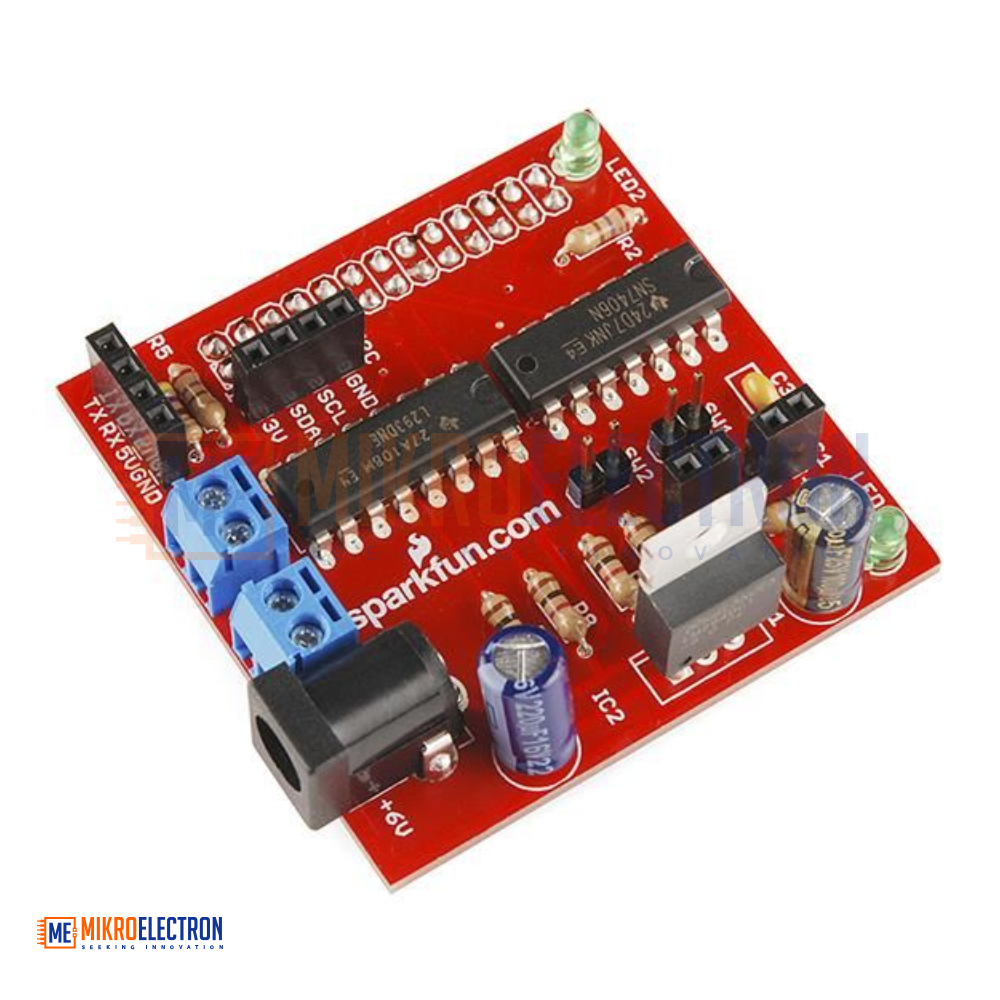
RaspiRobot Board
Out Of Stock
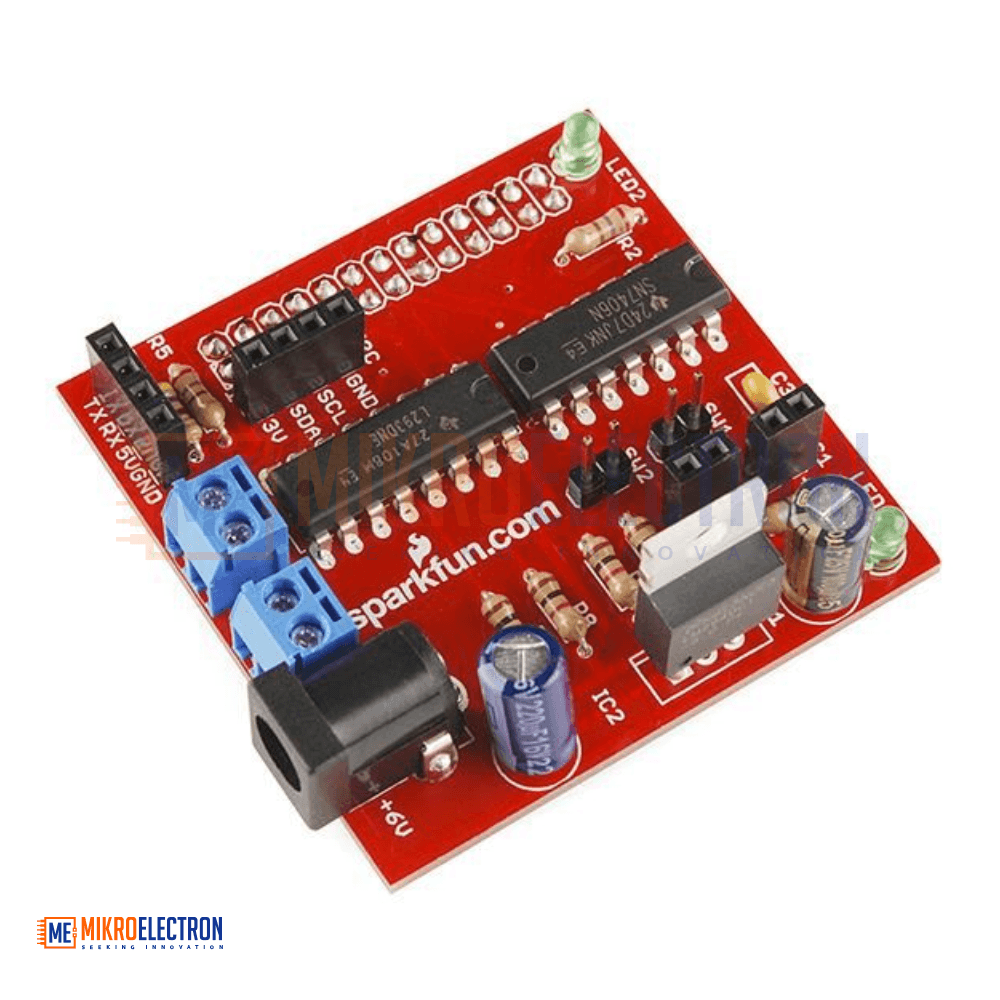
The RaspiRobot Board is a powerful Raspberry Pi expansion shield that transforms your Pi into a fully capable robot controller. It features dual bi-directional motor drivers, onboard 5V voltage regulator (powers the Pi from 7–12V batteries), 2 open-collector outputs, 2 switch inputs, 2 status LEDs, and 5V serial / 3.3V I2C connectors. Includes an easy-to-use Python library — perfect for DIY robotics, computer vision robots, web-controlled bots, and educational STEM projects.
لوحة RaspiRobot هي شيلد توسعة قوي للراسبيري باي يحوّل جهازك إلى متحكم روبوت متكامل. تتميز بـ مشغّل محرك ثنائي الاتجاه مزدوج، منظم جهد 5 فولت مدمج (يشغّل الراسبيري باي من بطاريات 7-12 فولت)، مخرجين open-collector، مدخلين للمفاتيح، مؤشرَي LED، وموصلَي Serial 5 فولت وI2C 3.3 فولت. تتضمن مكتبة Python سهلة الاستخدام — مثالية لـ روبوتات DIY، روبوتات الرؤية الحاسوبية، الروبوتات بالتحكم عبر الويب، ومشاريع STEM التعليمية.
The RaspiRobot Board is a purpose-built Raspberry Pi expansion board designed to bridge the gap between the Pi's powerful processing capabilities and the real-world hardware needed for robotics. The Raspberry Pi packs plenty of computing power into a small, affordable package — making it an ideal "brain" for DIY robots, autonomous vehicles, and intelligent embedded systems. However, the Pi's GPIO is not capable of directly driving motors, and a motor controller is essential for any moving robot. The RaspiRobot Board solves this problem elegantly, transforming the Pi into a robot-ready platform with everything needed for a wide range of robotics projects.
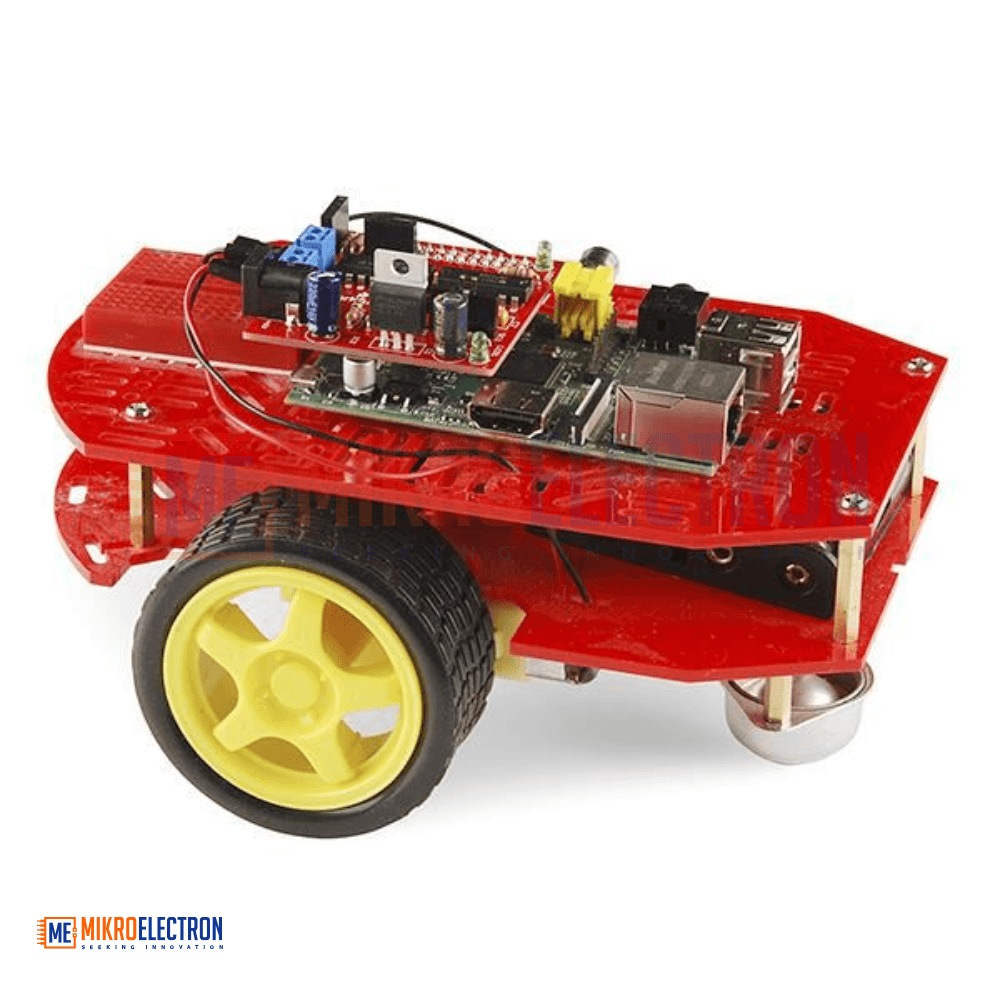
At the heart of the RaspiRobot Board is a dual H-bridge motor driver that can control two DC motors bi-directionally, allowing precise speed and direction control for both two-wheel-drive (2WD) and four-wheel-drive (4WD) robot platforms. The board also includes an onboard 5V switching voltage regulator that can power the Raspberry Pi directly from a 7V–12V battery source, eliminating the need for a separate power supply. This makes it perfect for untethered, mobile robotics applications like self-driving robots, exploration platforms, and autonomous toys.
In addition to motor control, the RaspiRobot Board offers a rich set of input and output features that make it useful for far more than just driving motors:
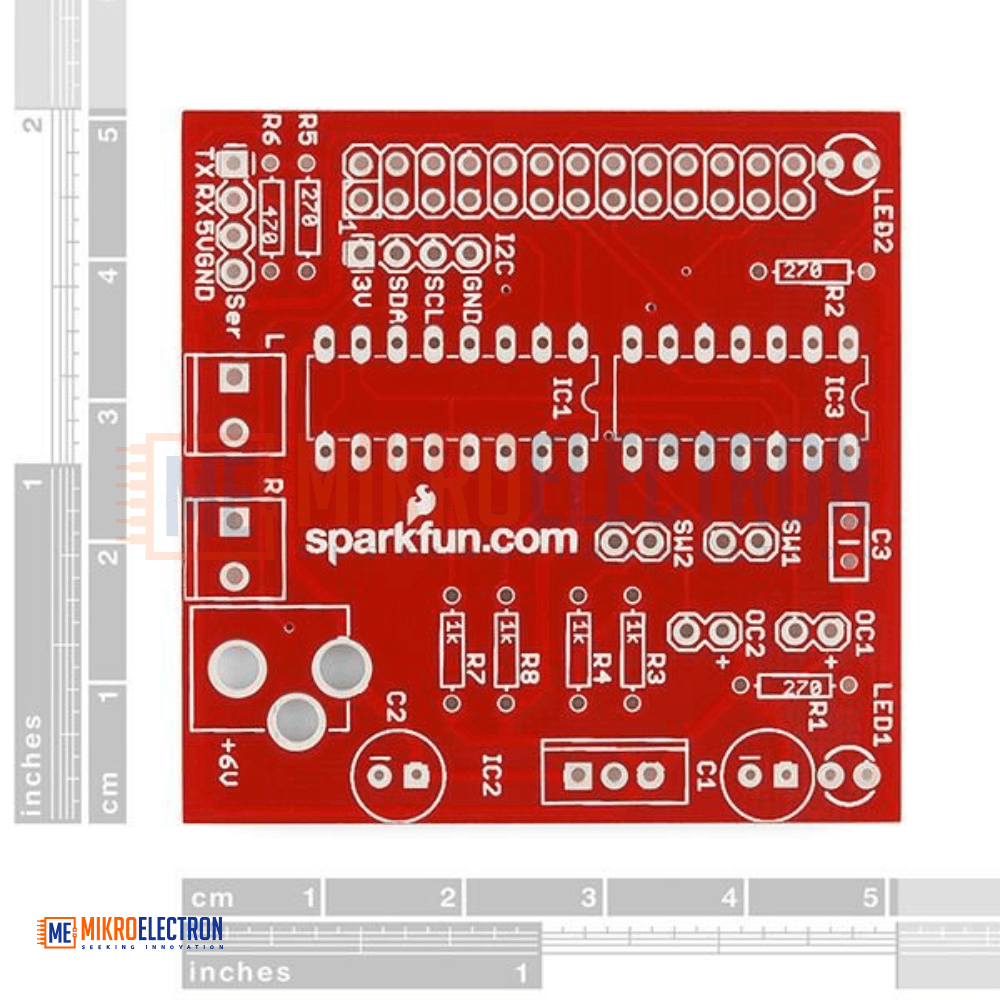
- 2 Open-Collector Outputs (25mA each) — for driving relays, LEDs, buzzers, or low-power loads
- 2 Switch Inputs — for connecting bumpers, limit switches, push-buttons, or external signals
- 2 Onboard Status LEDs — for visual feedback during operation and debugging
- 5V Serial Connector — for connecting serial peripherals like GPS modules, displays, or wireless modules
- 3.3V I2C Connector — for connecting sensors, OLED displays, sensor breakouts (BMP280, MPU6050, INA219, etc.)
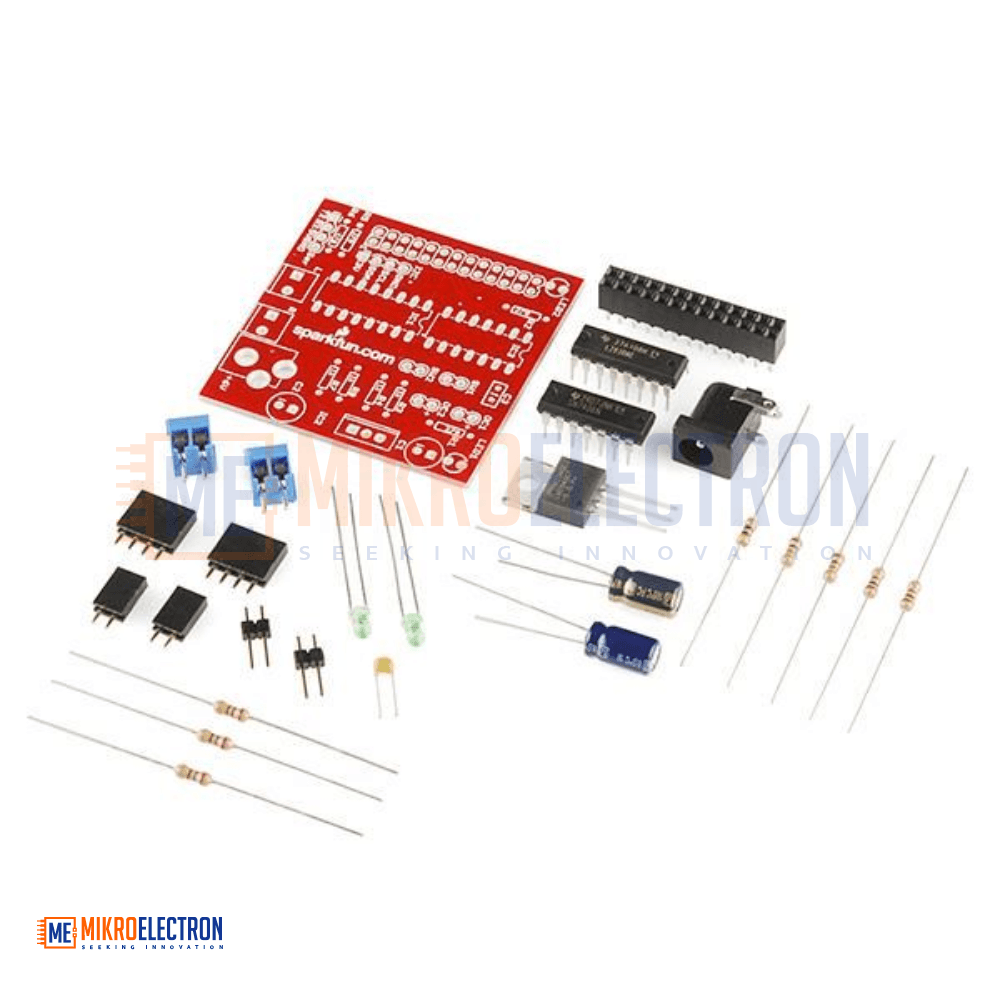
The board ships as a kit of through-hole components, which is easy to assemble with even a basic soldering iron and limited soldering experience. A complete step-by-step assembly guide is available online, walking you through every component placement and solder joint. After assembly, the RaspiRobot Board simply plugs onto the GPIO header of any Raspberry Pi (Model A, B, B+, 2, 3, 4, or Zero with the appropriate header) — no rewiring or breadboarding required.
What makes the RaspiRobot Board especially beginner-friendly is its dedicated Python library module, which abstracts the underlying GPIO and motor control logic into simple, intuitive function calls. Within minutes of assembly, you can write Python code to make your robot drive forward, turn, react to switch inputs, control external devices, or stream sensor data — all from the Raspberry Pi's familiar Linux environment.
The combination of Raspberry Pi + RaspiRobot Board opens up a world of advanced robotics possibilities that were previously the domain of expensive industrial platforms:
- Computer Vision Robotics — using OpenCV with the Pi camera
- Voice-Controlled Robots — leveraging speech recognition libraries
- Web-Controlled Robots — drive your robot from a phone or browser
- Autonomous Navigation — using sensors, GPS, and decision algorithms
- Machine Learning Robots — running TensorFlow Lite or PyTorch models on the Pi
- IoT-Connected Robots — uploading data to the cloud or receiving commands remotely
- Educational STEM Robots — perfect for teaching programming, electronics, and robotics
Whether you're a hobbyist building your first robot, a student working on a senior engineering project, or a maker creating an art installation, the RaspiRobot Board provides a clean, reliable, and capable hardware platform that takes the complexity out of motor control and lets you focus on the fun, creative, and intelligent parts of robotics.
Specifications
Motor Control
- Motor Channels: 2 (Dual H-Bridge)
- Direction: Bi-directional (forward/reverse)
- Motor Type: Standard DC motors
- Compatible Motor Voltage: Matches input battery voltage (typically 7–12V)
Power
- Input Voltage: 7V – 12V DC (battery or external supply)
- Onboard Regulator: 5V switching regulator (powers the Raspberry Pi)
- Output to Pi: Through GPIO header (5V on Pin 2/4)
I/O Features
- Open-Collector Outputs: 2 (25 mA each)
- Switch Inputs: 2 (with pull-ups)
- Status LEDs: 2 (user-controlled)
Connectors
- GPIO Header: Plugs into Raspberry Pi 26-pin GPIO
- Serial Port: 5V Serial connector (for serial peripherals)
- I2C Port: 3.3V I2C connector (for sensors and modules)
- Motor Output: 2-channel screw terminal block (typical)
- Power Input: Screw terminal block (typical)
Compatibility
- Raspberry Pi Models: A, B, B+, 2, 3, 4, Zero, Zero W, Zero 2 W
- Programming: Python (with dedicated raspirobotboard library)
- OS: Raspberry Pi OS (Raspbian) and other Linux distributions
Form Factor
- Type: Through-hole component kit (assembly required)
- Mounting: Plugs onto Raspberry Pi GPIO header
Applications
- DIY mobile robots — 2WD and 4WD platforms
- Educational robotics — schools, universities, STEM camps
- Computer vision robots — using Pi Camera and OpenCV
- Web-controlled robots — Wi-Fi remote control via Flask, Node-RED, etc.
- Voice-controlled robots — using speech recognition APIs
- Autonomous navigation robots — with ultrasonic, IR, or LiDAR sensors
- Machine learning robots — TensorFlow Lite, PyTorch, image classification
- Telepresence robots — remote-controlled platforms with video streaming
- Line-following robots — combining sensors with intelligent control
- Maze-solving robots — using algorithms and sensor feedback
- IoT-connected robots — receiving cloud commands or uploading data
- Surveillance and monitoring rovers — with camera and remote control
- Hackathons, robotics competitions, and student projects
- Art installations with motorized elements
- Greenhouse and agriculture robots for automated tasks
- Home automation and smart appliance prototypes