


Arduino Wi-Fi Shield
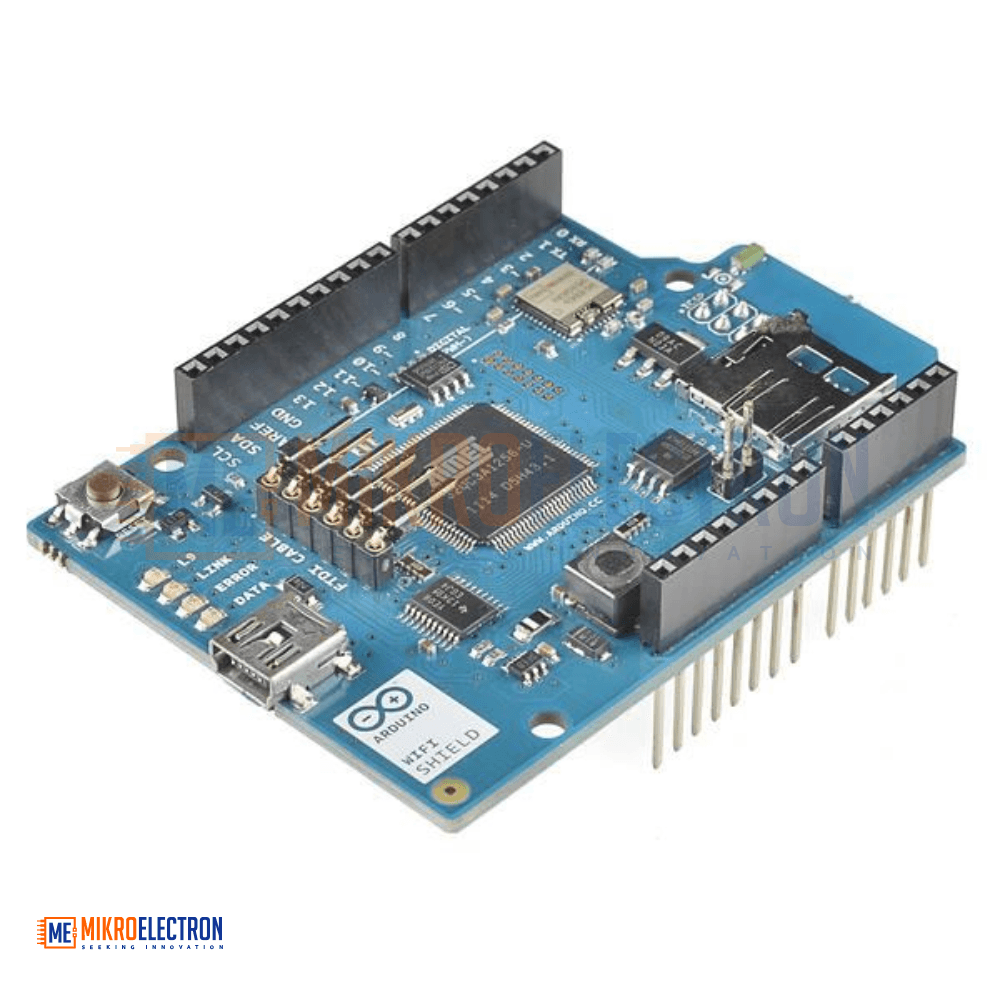
The Arduino Wi-Fi Shield brings full 802.11b/g wireless internet connectivity to your Arduino projects. Built around the HDG204 Wireless LAN module with an Atmega 32UC3 providing the TCP/UDP IP stack, it supports WEP and WPA2 Personal encryption. Includes an onboard micro SD slot for serving files, FTDI debug header, and micro-USB for firmware updates. Compatible with Arduino Uno and Mega, it's perfect for IoT, web servers, data logging, and remote-control projects.
درع Arduino Wi-Fi Shield يمنح مشاريع Arduino اتصالاً لاسلكياً كاملاً عبر 802.11b/g. يعتمد على وحدة HDG204 اللاسلكية مع متحكم Atmega 32UC3 الذي يوفّر مكدّس TCP/UDP، ويدعم تشفير WEP وWPA2 Personal. يتضمّن فتحة Micro SD على اللوحة لتخزين الملفات، وهيدر FTDI للتنقيح، وMicro-USB لتحديث البرامج الثابتة. متوافق مع Arduino Uno وMega، وهو مثالي لمشاريع IoT، خوادم الويب، تسجيل البيانات، والتحكم عن بُعد.
The Arduino Wi-Fi Shield allows any Arduino Uno or Mega board to connect directly to wireless networks (Wi-Fi) using the 802.11b/g specification, opening the door to a wide range of internet-connected (IoT) projects — from web-controlled devices and remote sensors to small embedded web servers.
The shield is based on the HDG204 Wireless LAN 802.11b/g System-in-Package combined with an Atmel ATmega 32UC3 microcontroller, which runs an embedded TCP/UDP IP stack. This means all networking work — DHCP, DNS, TCP/UDP socket handling — is offloaded from your Arduino's main MCU, leaving more CPU cycles for your application logic.
A key feature of this shield is its stackable design: the long wire-wrap headers pass through the shield, preserving the original Arduino pin layout and allowing additional shields to be stacked on top. This makes it easy to combine the Wi-Fi shield with displays, motor drivers, or sensor shields in the same project.
The board includes an onboard micro-SD card slot, accessible through the standard SD Library, allowing the shield to serve HTML pages, log data, or store configuration files directly from local storage. There's also an FTDI-style header for serial debugging of the shield itself, and a micro-USB connector for firmware updates, since the shield runs open-source firmware — making it possible to add new protocols, customize behavior, or even use the shield as a standalone Wi-Fi-connected microcontroller for advanced users familiar with C and the AVR32 family.
Key Technical Notes for Developers
- Wi-Fi communication: Uses the Arduino WiFi Library for sketch-level networking.
- SPI bus pins (shared with HDG204 and SD card):
- On Uno: digital pins 11, 12, 13.
- On Mega: digital pins 50, 51, 52.
- Chip-select pins:
- Pin 10 → HDG204 (Wi-Fi module)
- Pin 4 → SD card
- Pin 7 is used as a handshake between the Wi-Fi shield and the Arduino — do not use it for other I/O.
- On the Mega, hardware SS pin 53 is not used as a chip-select but must be kept as an output, otherwise the SPI interface will not work.
- Since the HDG204 and SD card share the SPI bus, only one can be active at a time. The standard libraries handle this automatically, but if you only use one peripheral, you must explicitly deselect the other (set its CS pin HIGH).
Encryption & Security
The shield supports WEP and WPA2 Personal encryption, allowing it to connect to most home and office Wi-Fi networks. (Enterprise WPA2 is not supported.)
Specifications
- Wireless Standard: 802.11b/g
- Wi-Fi Module: HDG204 Wireless LAN System-in-Package
- Network Processor: Atmel ATmega 32UC3 with TCP/UDP IP stack
- Encryption Support: WEP, WPA2 Personal
- Onboard Storage: Micro SD card slot (accessible via SD Library)
- Communication Bus: SPI (via ICSP header)
- Debug Interface: FTDI-style serial header
- Firmware Update Interface: Micro-USB
- Firmware: Open-source — extensible by the user
- Board Compatibility: Arduino Uno and Arduino Mega
- Stackable: Yes — long wire-wrap headers extend through the shield
- Reserved Pins: 4 (SD CS), 7 (handshake), 10 (Wi-Fi CS), 11/12/13 (Uno SPI) or 50/51/52 (Mega SPI)
Applications
- Internet of Things (IoT) projects with Arduino
- Wi-Fi-connected sensor nodes and data loggers
- Embedded web servers (HTML, JSON, REST APIs)
- Remote control of LEDs, relays, motors, and home appliances
- Home automation and smart home prototypes
- Cloud data uploading (ThingSpeak, MQTT, custom servers)
- Real-time monitoring dashboards
- Wireless weather stations and environmental sensors
- Robotics with wireless control via web or app
- Educational STEM projects involving networking
- Wi-Fi-enabled time clocks and information displays
- DIY security systems with remote alerts