
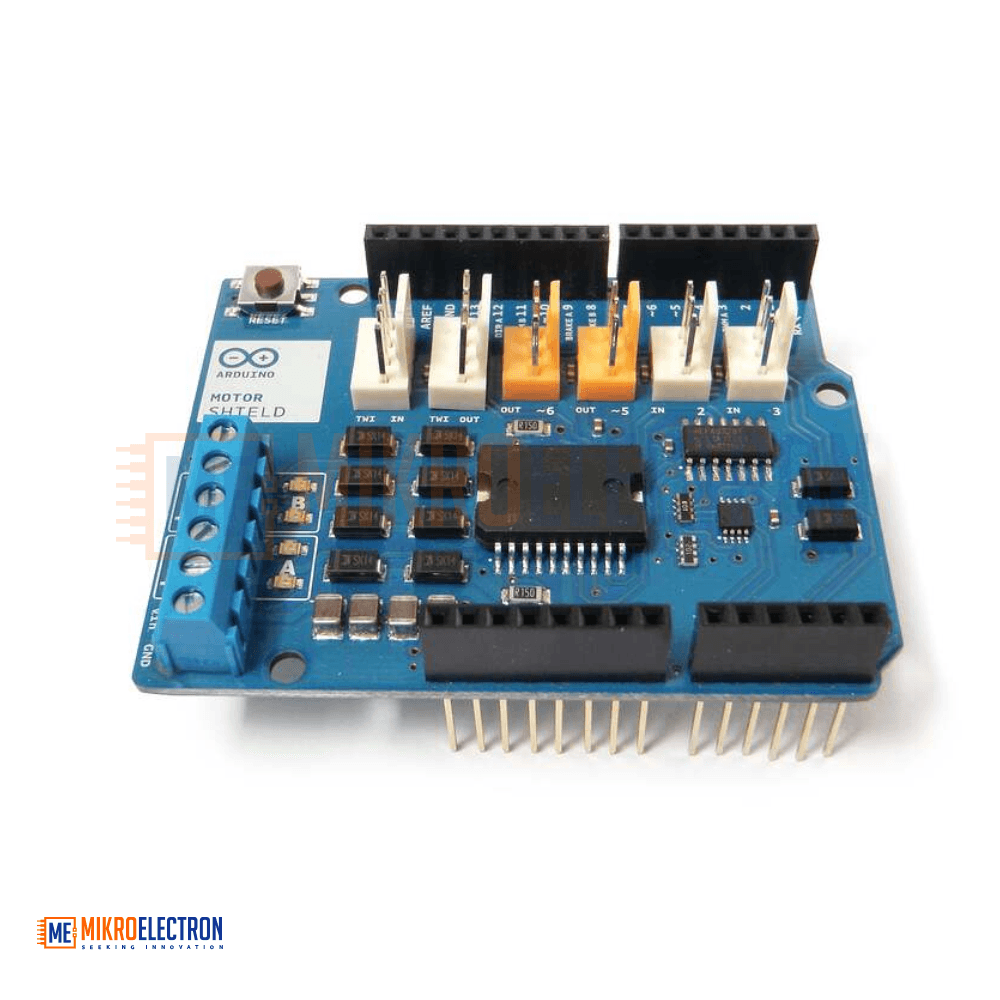
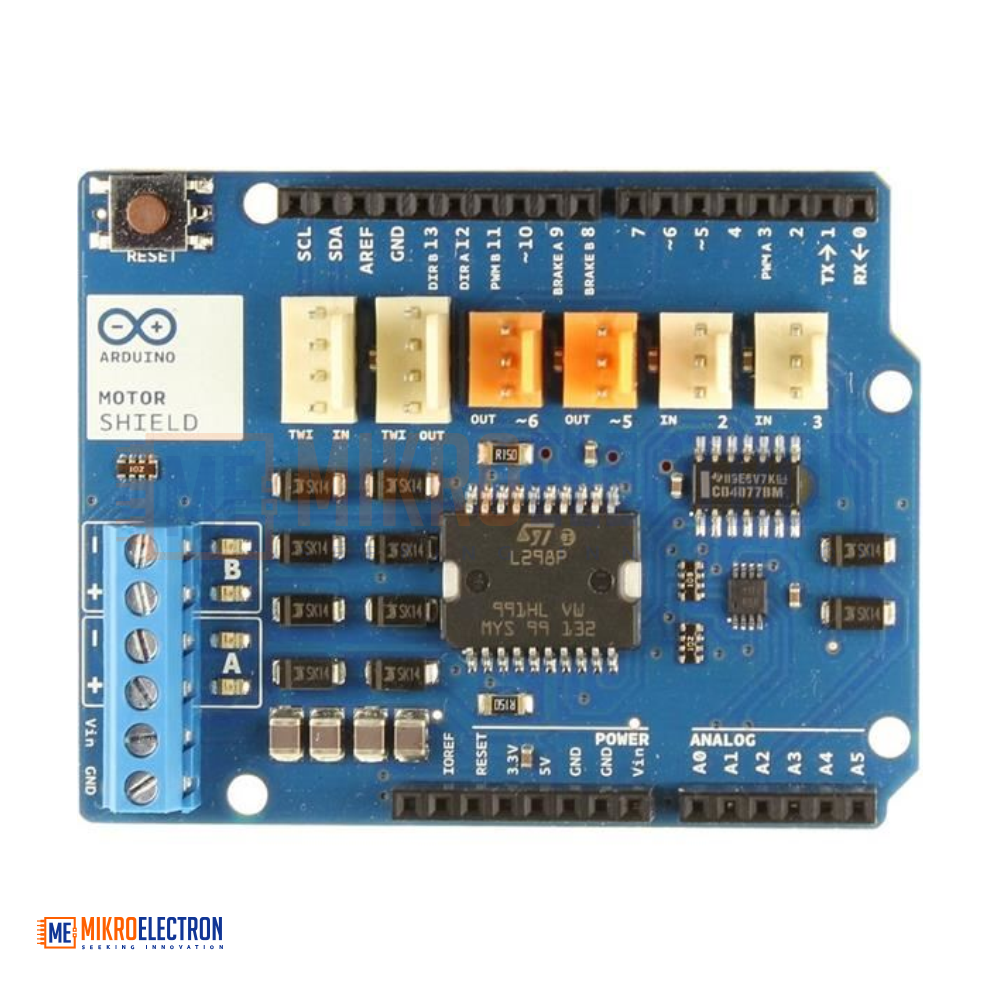
Arduino Motor Shield
The Arduino Motor Shield is a versatile motor driver board based on the L298P dual full-bridge driver, designed to plug directly onto your Arduino. It drives two DC motors or one bipolar stepper motor with independent speed and direction control via PWM, plus brake function and current sensing (1.65V/A). Delivers up to 2A per channel (4A total) at 5V–12V. TinkerKit compatible for fast prototyping. Perfect for robotics, RC projects, and any application requiring reliable bidirectional motor control.
درع المحرك Arduino Motor Shield هو لوحة تحكم بالمحركات متعددة الاستخدامات مبنية على شريحة L298P ثنائية الجسر الكامل، ومصممة لتركّب مباشرة فوق لوحة Arduino. تتيح تشغيل محركَي تيار مستمر أو محرك خطوي ثنائي القطبية مع تحكم مستقل بالسرعة والاتجاه عبر PWM، إضافة إلى وظيفة الفرملة واستشعار التيار. توفر تياراً يصل إلى 2 أمبير لكل قناة (4 أمبير إجمالاً) بجهد 5–12 فولت. متوافقة مع TinkerKit. مثالية للروبوتات ومشاريع التحكم بالحركة.
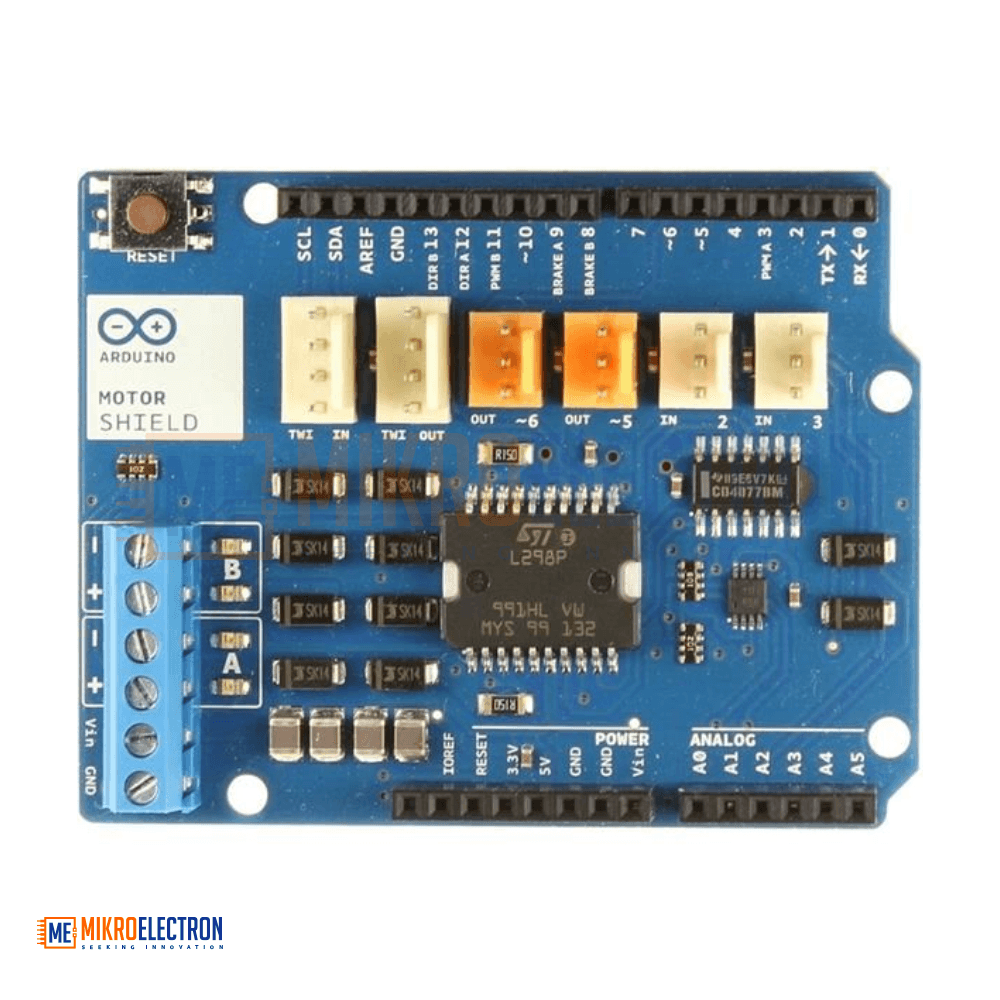
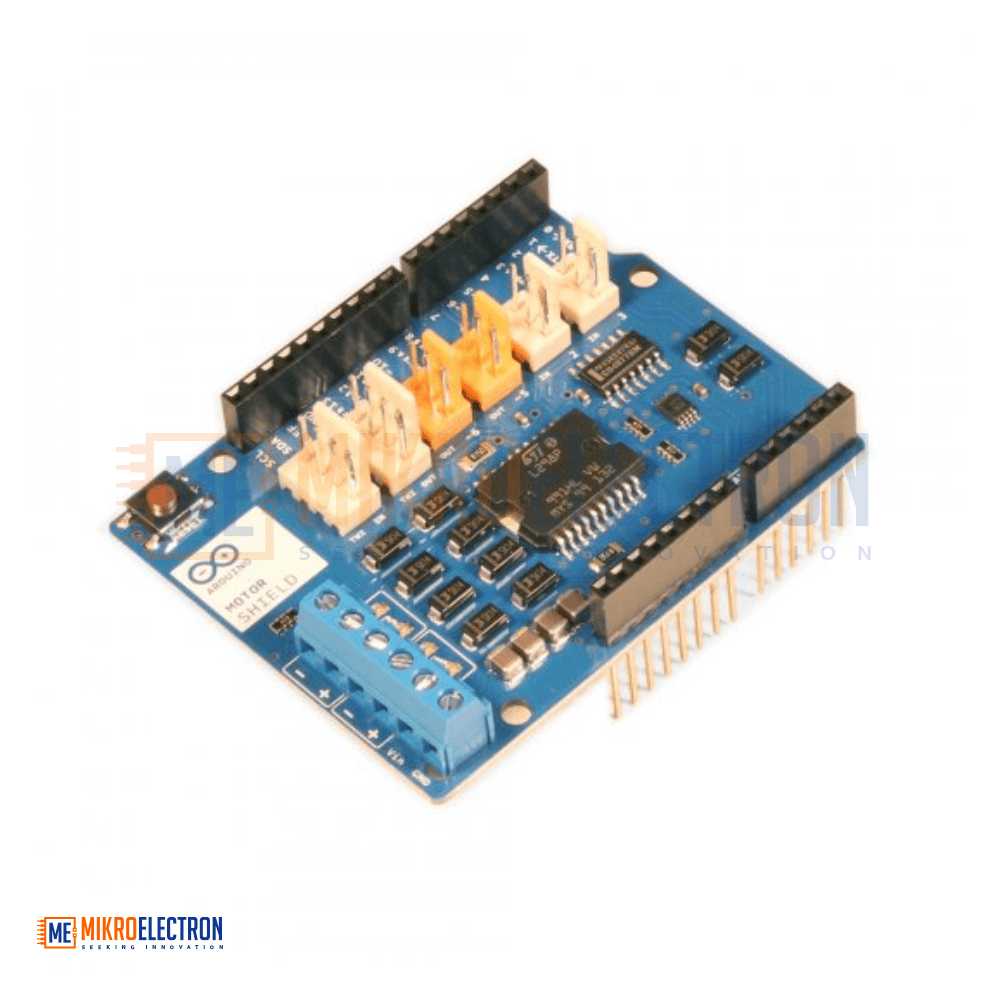
The Arduino Motor Shield is an official Arduino-compatible expansion board built around the powerful L298P dual full-bridge motor driver. It is designed to drive inductive loads such as DC motors, stepper motors, solenoids, and relays, giving you a clean, reliable way to add bidirectional motor control to your Arduino projects without the complexity of wiring up a discrete driver circuit.
The shield supports two independent motor channels (A and B), each capable of driving a brushed DC motor with full control over speed (PWM), direction (HIGH/LOW), active braking, and current sensing. Alternatively, the two channels can be combined to drive one bipolar stepper motor — making this shield extremely versatile for robotics, CNC, and automation projects.
A standout feature of this shield is its current sensing capability: each channel outputs a voltage proportional to the motor current (calibrated to 1.65V/A, reaching 3.3V at the maximum 2A), allowing your Arduino to monitor motor load in real time. This is invaluable for detecting stalls, jams, or implementing closed-loop control.
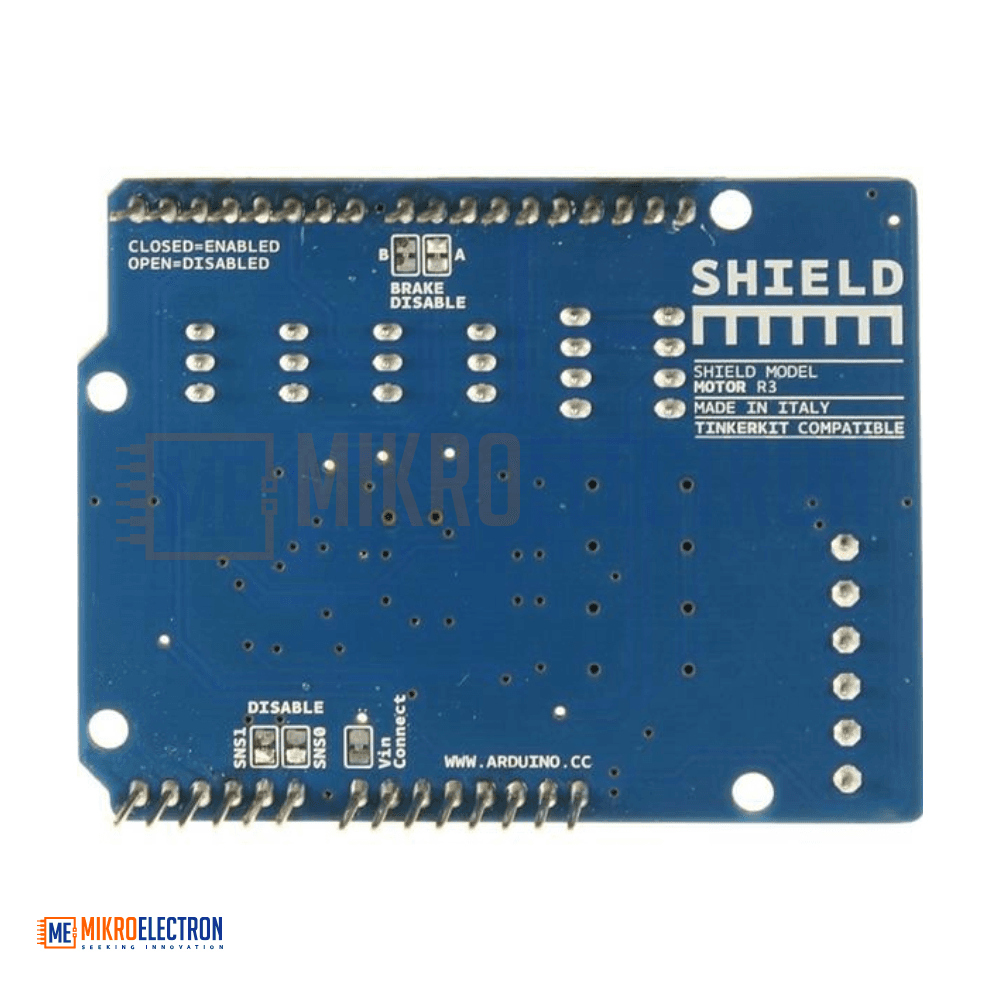
The shield must be powered from an external power supply (7V–12V recommended) because motor current frequently exceeds USB capacity. A "Vin Connect" jumper on the back of the shield lets you isolate the motor power from the Arduino's main power line, which is recommended when driving motors that require more than 9V — protecting your Arduino from voltage spikes.
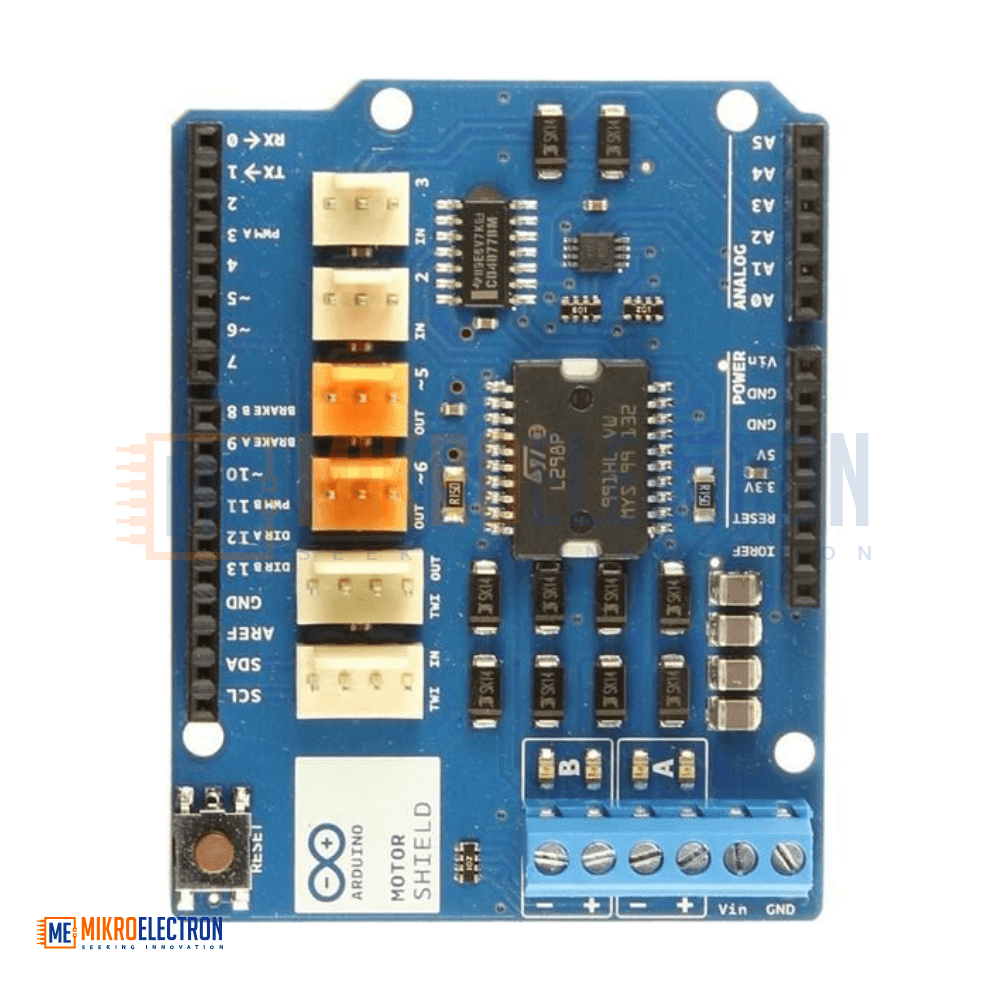
For rapid prototyping, the shield is TinkerKit compatible, with built-in connectors for analog inputs, analog outputs (PWM), and the TWI (I2C) bus. This makes it easy to plug in sensors, actuators, and modules without breadboarding.
Specifications
- Motor Driver IC: L298P dual full-bridge driver
- Operating Voltage: 5V to 12V (external supply recommended)
- Maximum Vin (screw terminals): 18V (absolute limit)
- Maximum Current: 2A per channel — 4A total (with adequate external power)
- Number of DC Motors: Up to 2 brushed DC motors
- Stepper Motor Support: 1 bipolar stepper motor (using both channels)
- Speed Control: PWM on D3 (Channel A) and D11 (Channel B)
- Direction Control: Digital pins D12 (DIR A) and D13 (DIR B)
- Brake Control: Digital pins D9 (Brake A) and D8 (Brake B)
- Current Sensing: Analog pins A0 (SNS0) and A1 (SNS1)
- Current Sensing Calibration: 1.65V per Amp (3.3V at 2A maximum)
- TinkerKit Connectors:
- 2 × Analog Inputs (white, A2 and A3)
- 2 × Analog Outputs / PWM (orange, D5 and D6)
- 2 × TWI (I2C) Connectors (white, 4-pin)
- Power Connection: 2.1 mm center-positive jack (via Arduino) or screw terminal (Vin, GND)
- Motor Connection: Screw terminals for each channel (+ and –)
- Vin Connect Jumper: Cuttable to isolate motor and Arduino power
- PCB Dimensions: 2.7 × 2.1 inches
- Mounting: 4 screw holes for fixed installation
- Compatibility: Arduino Uno, Mega, Leonardo, and other Arduino boards with standard shield headers
Pin Usage Summary
| Function | Channel A | Channel B |
|---|---|---|
| Direction | D12 | D13 |
| PWM (Speed) | D3 | D11 |
| Brake | D9 | D8 |
| Current Sense | A0 | A1 |
Tip: If you don't need brake or current-sensing functionality, you can cut the corresponding jumpers on the back of the shield to free up those Arduino pins for other uses.
Power Supply Notes
- Always use an external power supply. USB power alone is not sufficient for most motors.
- Recommended voltage: 7V to 12V
- For motors over 9V: Cut the "Vin Connect" jumper on the back of the shield to separate motor power from the Arduino's Vin line. This protects your Arduino from motor-induced voltage spikes.
- Absolute maximum Vin: 18V (do not exceed)
- Respect polarity when connecting power to Vin and GND screw terminals
Applications
- Robotics – Drive wheels, tracks, and motorized arms
- RC Cars & Vehicles – Control DC motors with Arduino-based remote systems
- 3D Printers & CNC Machines – Drive bipolar stepper motors
- Conveyor Belts & Automation – Industrial-style motor control prototypes
- Educational Robotics – Teach motor control, PWM, and H-bridge concepts
- DIY Drones & Submarines – Drive small propulsion motors
- Camera Sliders & Pan/Tilt Systems – Smooth, controlled motor motion
- Animatronics – Bring kinetic projects to life
- Smart Home Projects – Motorized curtains, blinds, and locks
- Stepper-Driven Mechanisms – Position-controlled actuators
- Solenoid Control – Drive inductive loads other than motors
- Current Monitoring Applications – Detect stalls, jams, and motor load conditions