
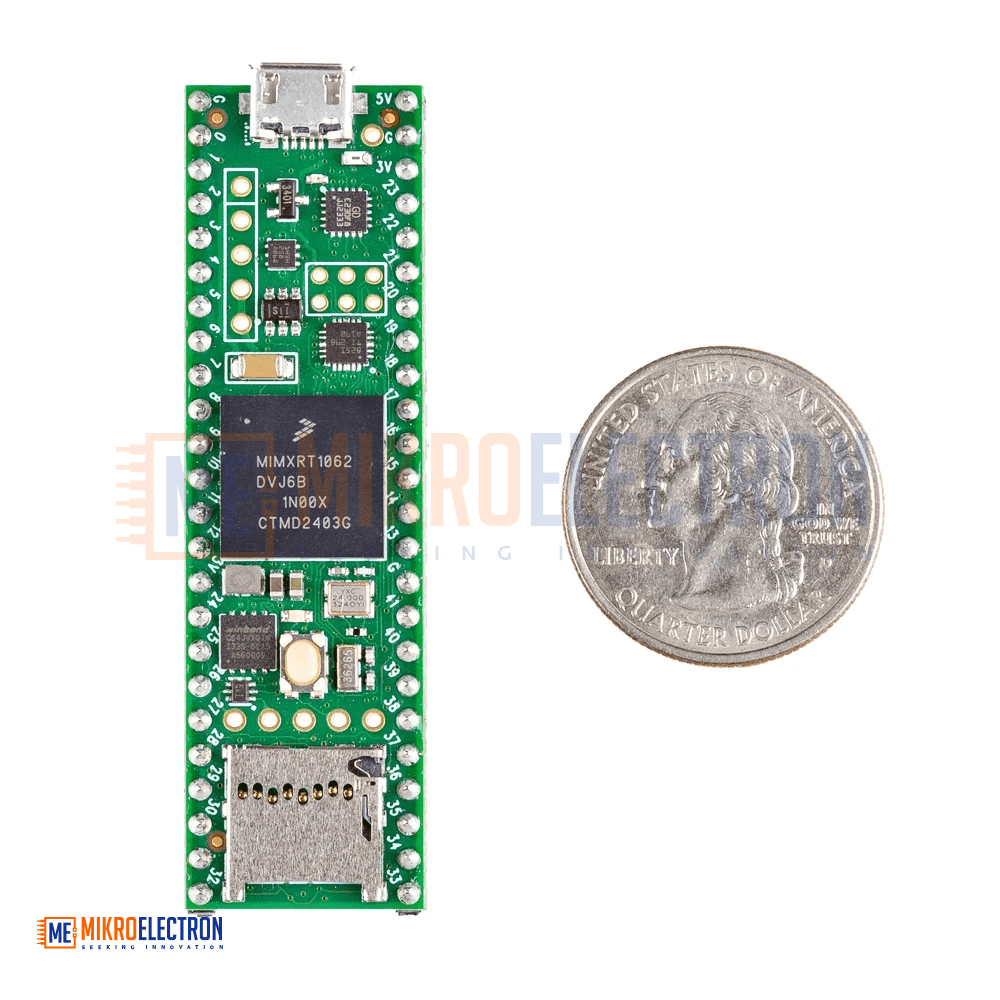
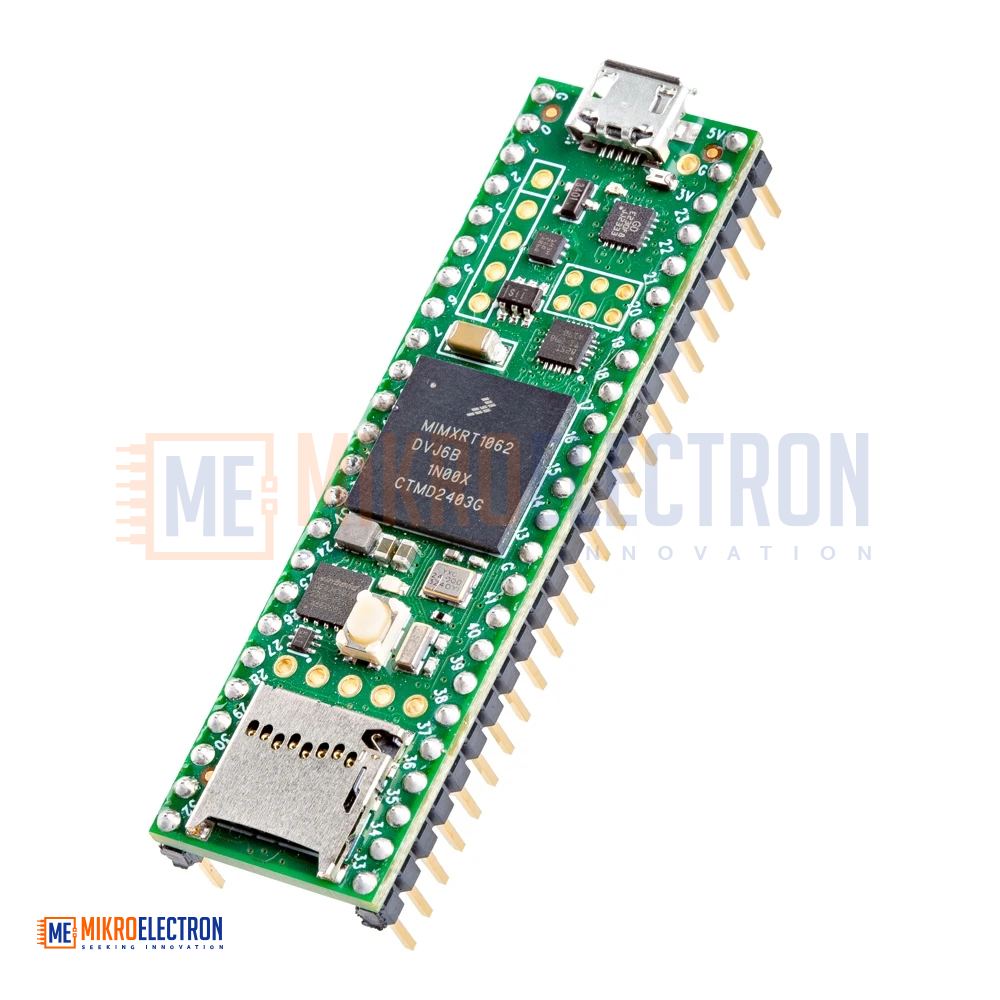
Teensy 4.1 (Headers)
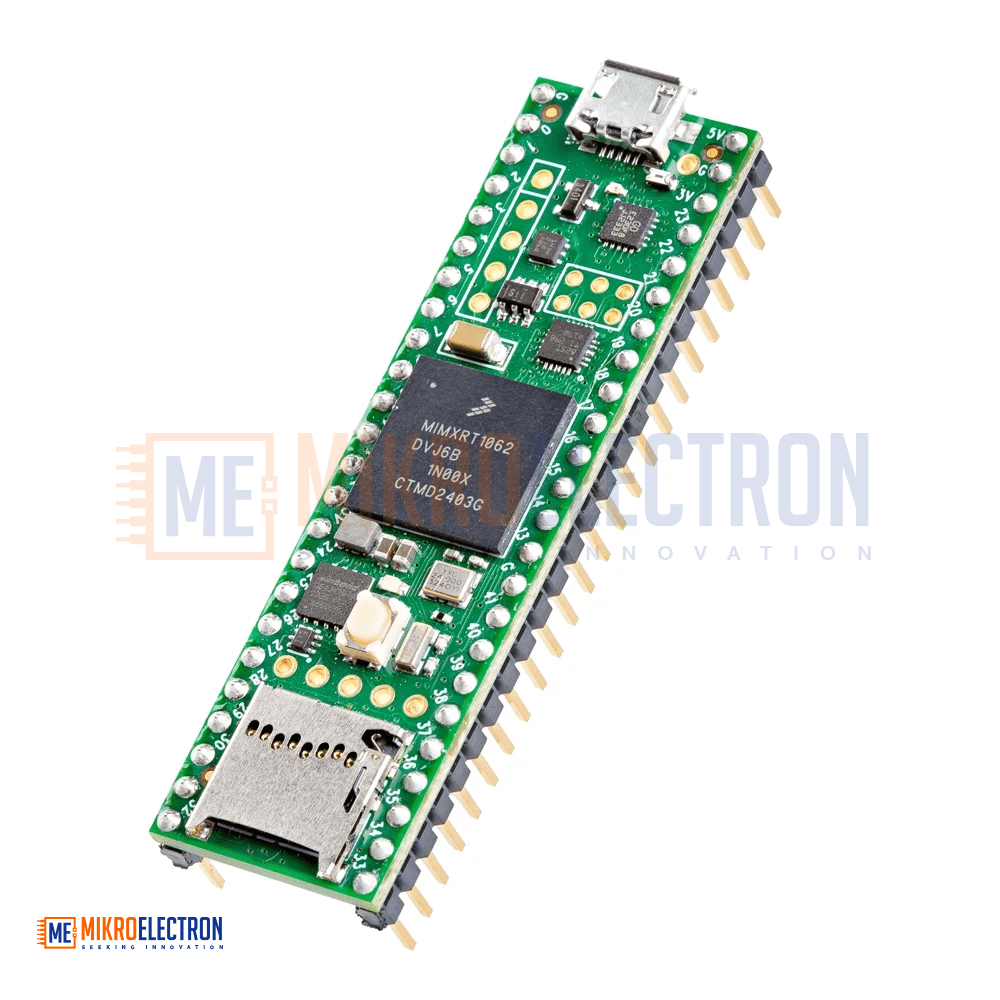
The Teensy 4.1 (Headers) is a high-performance development board powered by the NXP ARM Cortex-M7 processor running at 600MHz, now supplied with pre-soldered male headers for immediate, solder-free prototyping. It offers 8MB of Flash, 1024K RAM, and 55 total I/O pins, including 35 PWM pins and 18 analog inputs. Built-in connectivity includes a 10/100 Mbit Ethernet PHY, microSD card socket, and USB Host port, plus 8 serial ports, 3 SPI, and 3 CAN Bus interfaces. With a hardware FPU, RTC, and cryptographic acceleration, it is ideal for demanding, connected, and real-time projects.
Teensy 4.1 (مع أرجل ملحومة) هي لوحة تطوير عالية الأداء تعمل بمعالج NXP ARM Cortex-M7 بسرعة 600 ميغاهيرتز، وتأتي الآن مزودة بأرجل توصيل ذكرية ملحومة مسبقاً مما يتيح البدء الفوري ببناء النماذج دون الحاجة إلى اللحام. توفر ذاكرة Flash بسعة 8 ميغابايت، وذاكرة RAM بسعة 1024 كيلوبايت، و55 طرف إدخال/إخراج، منها 35 طرف PWM و18 مدخلاً تماثلياً. وتشمل خيارات الاتصال المدمجة منفذ إيثرنت 10/100 ميغابت، ومقبس بطاقة microSD، ومنفذ USB Host، بالإضافة إلى 8 منافذ تسلسلية و3 منافذ SPI و3 منافذ CAN Bus. وبفضل وحدة الفاصلة العائمة (FPU) وساعة الوقت الحقيقي (RTC) وتسريع التشفير، تُعد مثالية للمشاريع المتقدمة والمتصلة بالشبكة وتطبيقات الزمن الحقيقي.
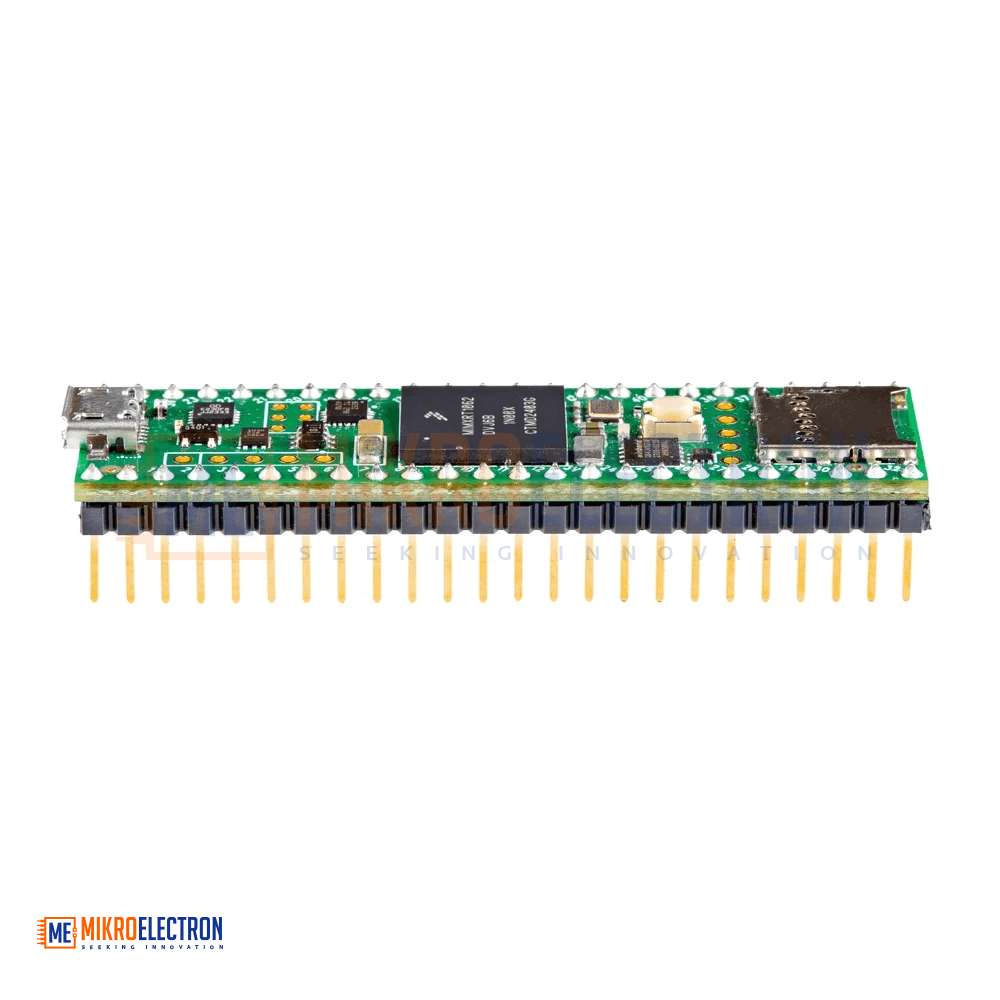
The Teensy 4.1 (Headers) is a major expansion of the popular Teensy development platform, delivering the record-breaking 600MHz performance of the Teensy 4.0 in a larger board designed for large-scale projects, and now shipped with pre-soldered headers so you can start building right away with no soldering required.
Powerful Cortex-M7 Core
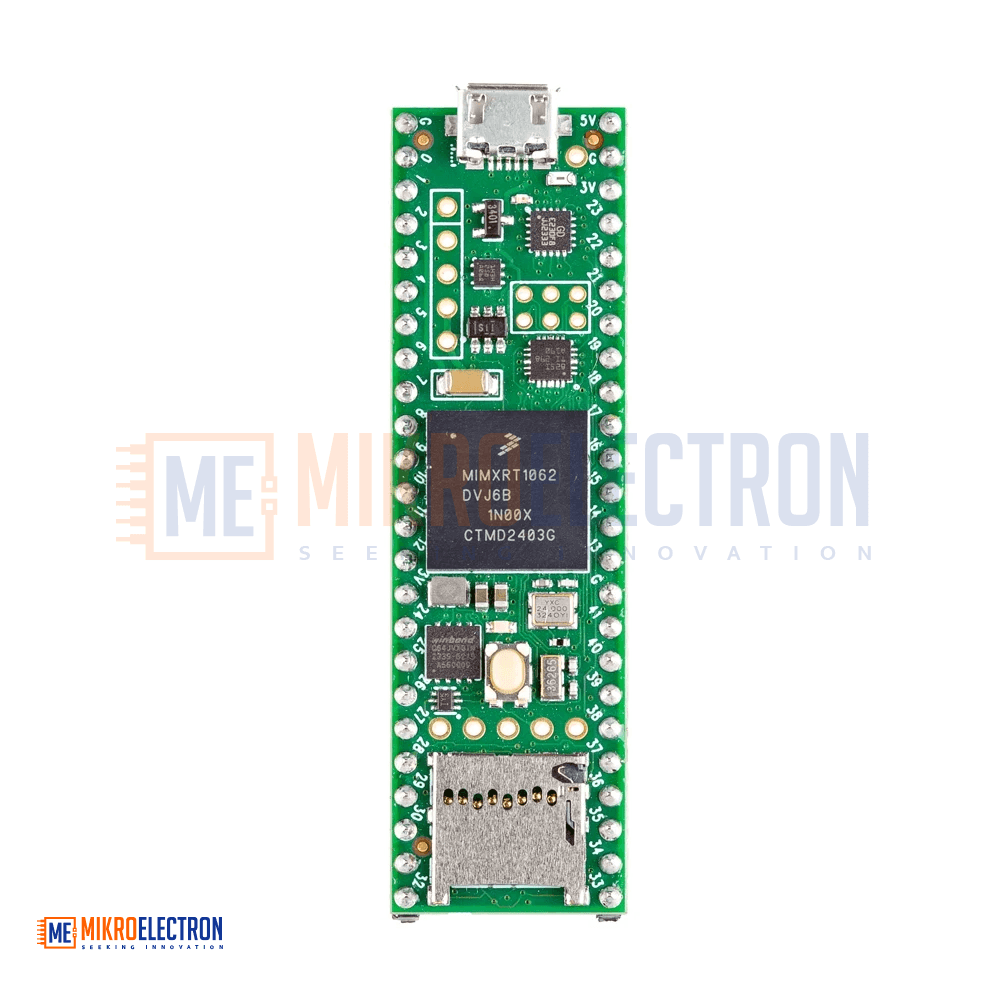
At the heart of the board is the NXP MIMXRT1062DVJ6B "Crossover MCU", which bridges the gap between low-cost microcontrollers and high-performance application processors. It uses the same 600MHz ARM Cortex-M7 core as the Teensy 4.0 but in a larger 196-pin package, which allows the Teensy 4.1 to break out extra I/O, native Ethernet, the SDIO interface, and the USB Host port.
- Dual-issue superscalar architecture: executes two instructions per clock cycle, which Arduino-compiled C++ code achieves 40 to 50 percent of the time, greatly accelerating numerically intensive work.
- Branch prediction: the first ARM microcontroller to use it, allowing loop branches to run in a single clock cycle instead of wasting three cycles as on the Cortex-M4.
- Hardware FPU: full hardware acceleration for both 64-bit double and 32-bit float types, so functions like log(), sin(), and cos() run at full hardware speed.
Advanced and Expandable Memory
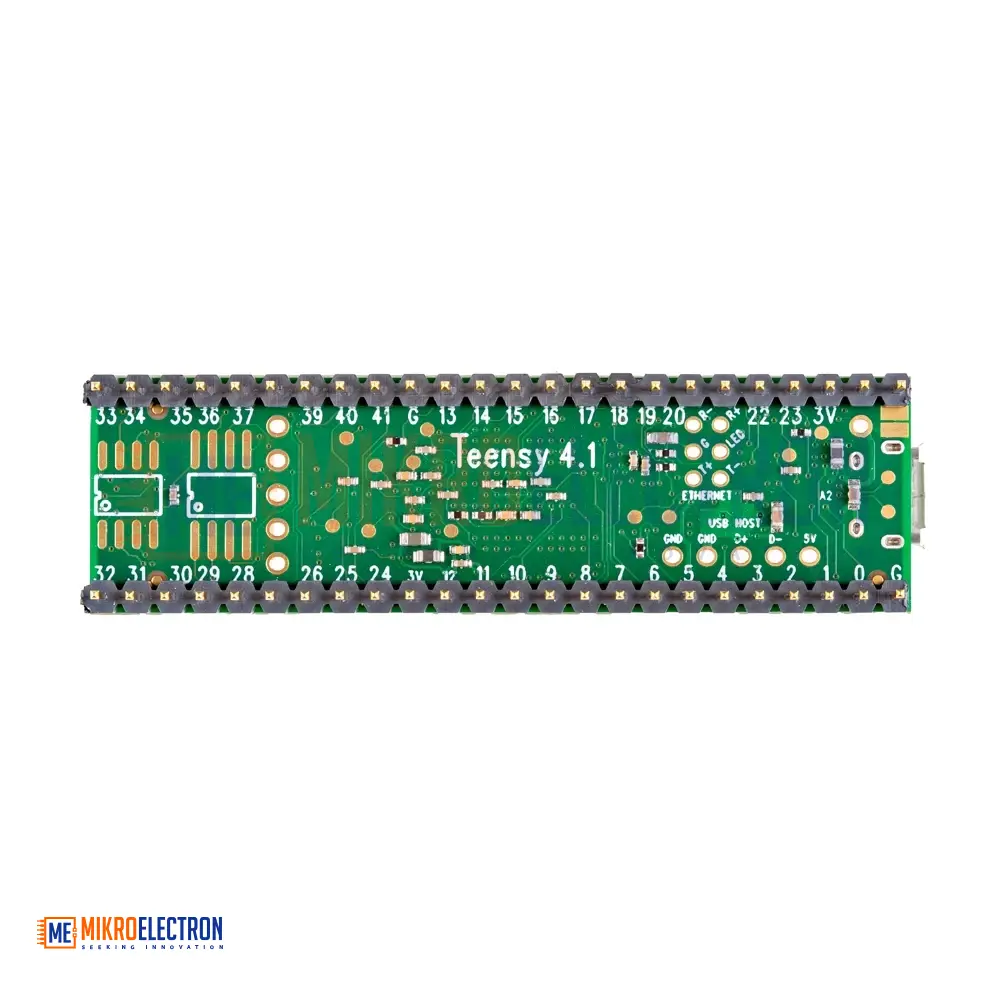
The Teensy 4.1 provides 8MB of Flash (four times larger than the Teensy 4.0) and 1024K of RAM, of which 512K is Tightly Coupled Memory (TCM) offering single-cycle access through dedicated high-speed buses. The Teensyduino environment automatically places your sketch code in this fast memory, while DMA-based peripherals access other memory efficiently through the separate AXI bus, minimizing I/O bottlenecks. Two additional pads on the bottom of the board allow optional soldering of up to 16MB of PSRAM or a QSPI Flash chip for even larger applications.
Efficient Power Management
The board consumes approximately 100mA at 600MHz and supports dynamic clock scaling, meaning CPU speed can be changed on the fly without breaking serial baud rates, audio sample rates, or timing functions like delay() and millis(). A dedicated On/Off pin can fully disable the 3.3V supply: hold a pushbutton for five seconds to power down and press briefly to turn it back on. With a coin cell connected to VBAT, the built-in RTC keeps date and time while main power is off. Advanced users can also overclock well beyond 600MHz.
Connectivity and Form Factor
Using the larger Teensy 3.6 form factor (2.4 in x 0.7 in), the Teensy 4.1 adds a built-in 10/100 Mbit Ethernet PHY, a microSD card socket, and a USB Host port, making it a true hub for complex, connected devices. With the pre-soldered headers, it is instantly breadboard-friendly.
Specifications
| Parameter | Value |
|---|---|
| Processor | NXP MIMXRT1062DVJ6B (196-pin package) |
| CPU Core | ARM Cortex-M7 |
| Clock Speed | 600 MHz (overclockable) |
| Flash Memory | 8 MB (256K reserved for recovery and EEPROM emulation) |
| RAM | 1024K (512K Tightly Coupled Memory) |
| Expansion Memory | 2 chip locations for PSRAM (up to 16MB) or QSPI Flash |
| Floating Point Unit | Hardware FPU (64-bit double and 32-bit float) |
| Total I/O Pins | 55 |
| Breadboard-Friendly I/O | 42 |
| Bottom SMT Pad Signals | 7 |
| PWM Pins | 35 |
| Analog Inputs | 18 |
| Serial Ports | 8 |
| SPI | 3 (all with 16-word FIFO) |
| CAN Bus | 3 (1 with CAN FD) |
| Digital Audio | 2 x I2S, 1 x S/PDIF |
| SD Interface | 1 x SDIO (4-bit) native SD, microSD card socket |
| Ethernet | 10/100 Mbit DP83825 PHY (6 pins) |
| USB | USB device port, USB Host port |
| DMA Channels | 32 general purpose |
| Security | Cryptographic acceleration, random number generator |
| Other Peripherals | RTC, programmable FlexIO, Pixel Processing Pipeline, peripheral cross triggering |
| Current Consumption | Approx. 100 mA at 600 MHz |
| Power Management | On/Off pin, dynamic clock scaling, VBAT for RTC |
| Dimensions | 2.4 in x 0.7 in (approx. 61 mm x 18 mm) |
| Headers | Pre-soldered male headers |
| Programming Environment | Arduino IDE with Teensyduino |
Applications
- High-performance audio processing, synthesizers, and digital effects
- Networked and IoT devices using the built-in Ethernet
- Data logging with microSD storage
- USB Host projects such as MIDI controllers, keyboards, and USB device interfaces
- Automotive and industrial systems using CAN Bus and CAN FD
- Robotics, drones, and motor control requiring fast real-time processing
- LED displays and lighting control with many PWM outputs
- Signal processing and DSP with hardware floating point math
- Rapid prototyping on breadboards without soldering
- Educational and research projects in embedded systems