
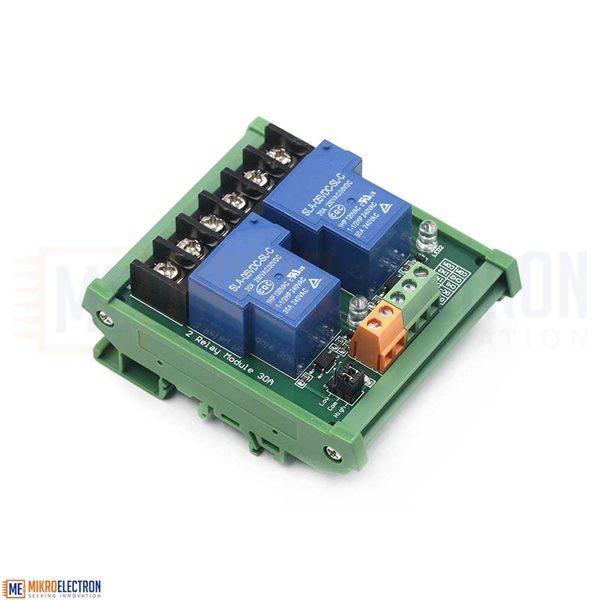
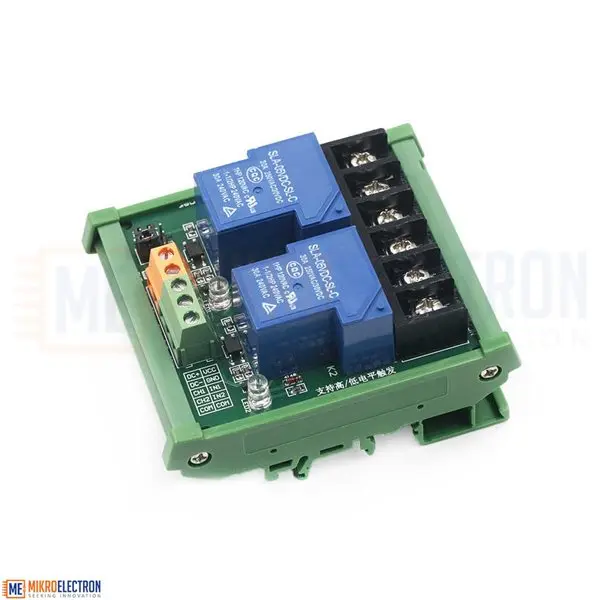
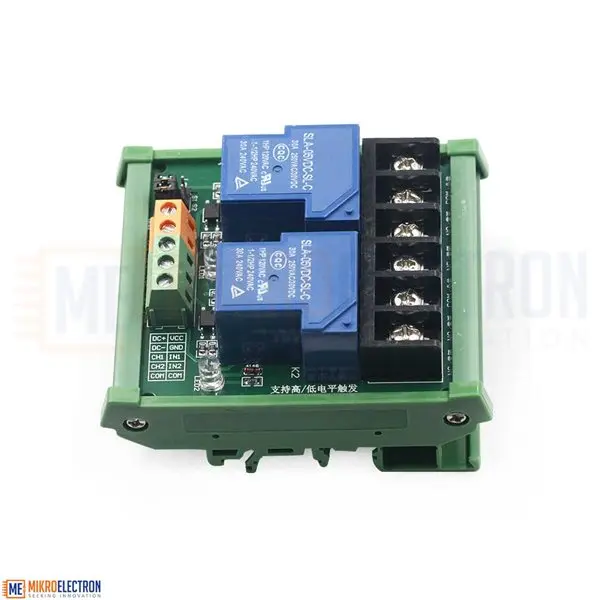
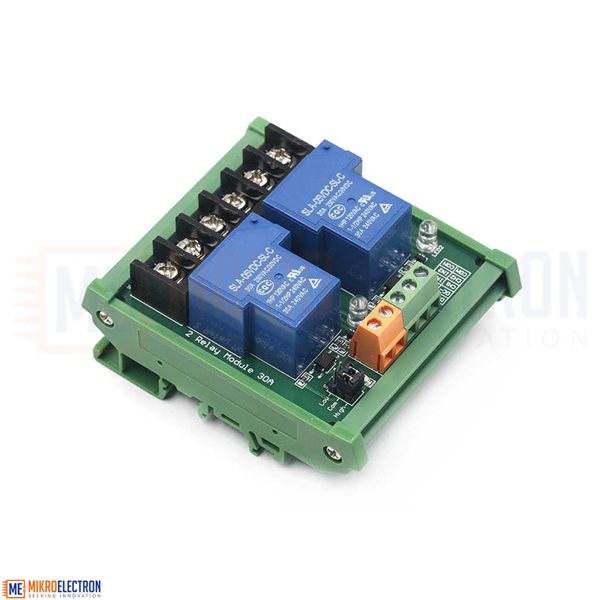
2 Channel Relay Module 30A with Optocoupler Isolation 5V Supports High and Low Trigger(with Guide Rail)
The 2-Channel 30A Relay Module is a high-current relay control board designed for switching AC and DC electrical loads. It features two high-quality 30A relays with optocoupler isolation, providing stable operation and protection between the control signal and relay circuit. The module operates from a 5V DC supply and supports both high-level and low-level trigger modes, selectable using a jumper. With a trigger current of approximately 2–5mA, it can be controlled by various microcontrollers and digital control systems. The module provides convenient terminal connections for power, trigger signals, and relay contacts. A guide rail mounting design allows easy installation in control cabinets and electrical enclosures.
وحدة ريليه بقناتين وتيار 30A هي لوحة تحكم عالية التيار مصممة للتحكم في الأحمال الكهربائية AC وDC. تحتوي على ريليهان عاليَا الجودة بقدرة 30A مع عزل بواسطة Optocoupler لتوفير تشغيل مستقر وفصل دائرة التحكم عن دائرة الريليه. تعمل الوحدة بجهد 5V DC وتدعم التشغيل بواسطة المستوى العالي أو المنخفض، مع إمكانية اختيار وضع التشغيل باستخدام Jumper. تتميز بتيار تشغيل منخفض للإشارة يبلغ حوالي 2–5mA، مما يجعلها مناسبة للتحكم بواسطة المتحكمات الدقيقة وأنظمة التحكم الرقمية. تحتوي على أطراف توصيل مريحة للطاقة والإشارة وملامسات الريليه، بالإضافة إلى تصميم مناسب للتركيب على Guide Rail.
The 2-Channel 30A Relay Module with Optocoupler Isolation is a high-current switching module designed for applications that require reliable control of electrical loads.
The module uses two high-quality 30A relays, with each relay providing NC, COM, and NO contacts for flexible load switching. According to the supplied specifications, the relay contacts can handle loads up to 250VAC/30A or 30VDC/30A.
A built-in optocoupler isolation circuit separates the trigger signal from the relay control circuitry, helping improve electrical isolation and system stability. The module has a low trigger current requirement, with the supplied specifications indicating approximately 2–4mA, while the general description specifies a 5mA trigger current.
The module operates from a 5V DC power supply and provides selectable high-level and low-level trigger modes. The trigger mode can be selected using the jumper: connecting the jumper to the L terminal configures low-level triggering, while connecting it to the H terminal configures high-level triggering.
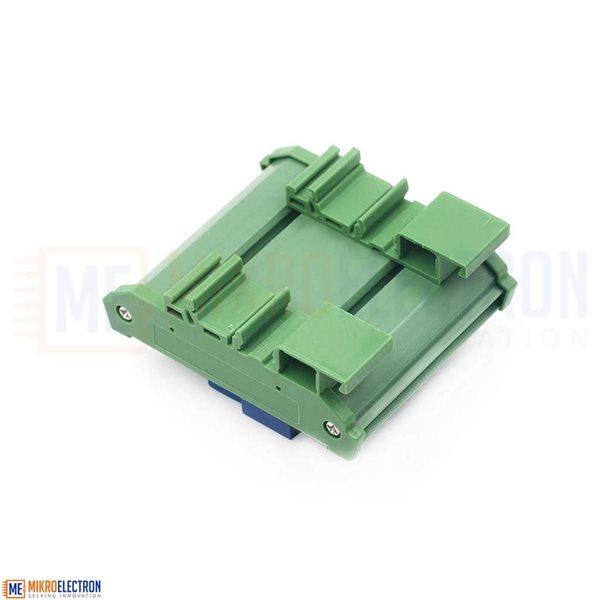
The module features a convenient terminal interface, allowing the power supply, trigger signal, and relay contacts to be connected directly. Its guide rail mounting design makes it suitable for installation in electrical cabinets, control panels, and automation systems.
Specifications
| Specification | Details |
|---|---|
| Product Type | 2-Channel High-Current Relay Module |
| Number of Channels | 2 |
| Relay Version | 5V |
| Working Voltage | 5V DC |
| Maximum AC Load | 250VAC / 30A |
| Maximum DC Load | 30VDC / 30A |
| Trigger Mode | High-Level / Low-Level |
| Trigger Current | Approx. 2–5mA |
| Optocoupler Isolation | Yes |
| Relay Contacts | NC / COM / NO |
| Static Current | 5mA |
| Maximum Current | 190mA |
| Material | ABS |
| Mounting | Guide Rail Compatible |
| Condition | 100% Brand New |
| Connection | Screw Terminal |
Terminal Definitions
| Terminal | Function |
|---|---|
| DC+ | Positive terminal of the 5V DC power supply |
| DC- | Negative terminal of the 5V DC power supply |
| IN | Relay trigger signal input |
| NC | Normally Closed contact |
| COM | Common relay contact |
| NO | Normally Open contact |
| H / L Jumper | Selects High-Level or Low-Level triggering |
Trigger Mode Selection
- L position: The IN terminal is triggered by a low-level signal.
- H position: The IN terminal is triggered by a high-level signal.
Applications
- High-current load switching
- Industrial automation
- Electrical control panels
- Motor control
- Lighting control
- Pump control
- Solenoid and actuator control
- Home automation
- Microcontroller projects
- PLC control systems
- DC and AC appliance control
- Electrical equipment control