
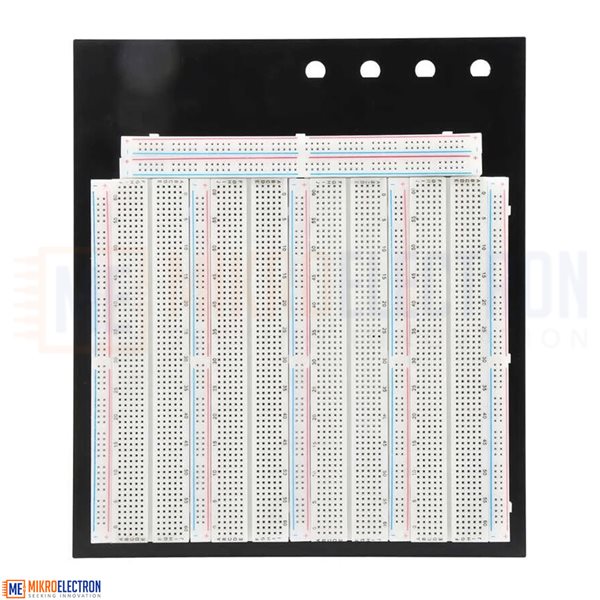
Solderless Breadboard 3220 Points
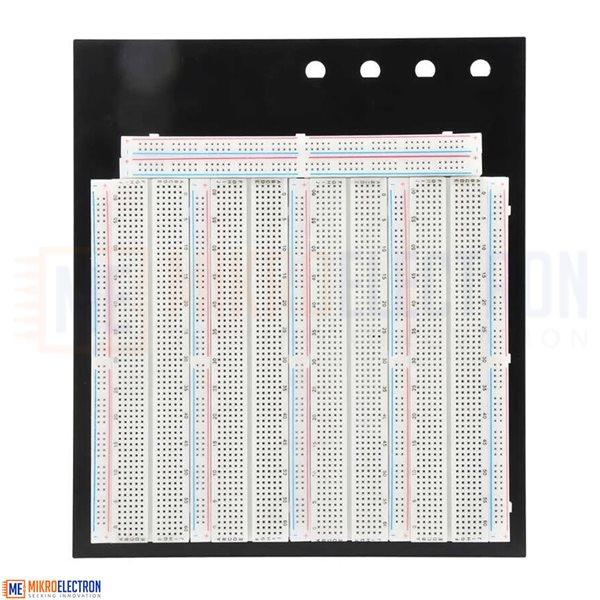
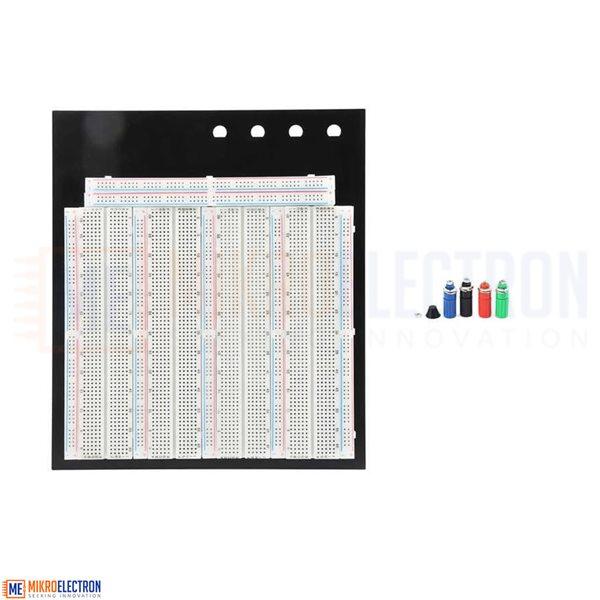
The 3220-Point Solderless Breadboard is a large-scale prototyping platform ideal for building, testing, and experimenting with complex electronic circuits without any soldering. It combines 4 terminal strips (2520 tie points), 7 distribution strips (700 tie points), and 4 binding posts for easy power connection, all mounted on a sturdy ABS body with an aluminum backing plate. The board accepts 20–29 AWG wires with a 0.8mm diameter and handles up to 300V / 3–5A. Suitable for hobbyists, students, engineers, and robotics builders, it is a reusable, modular, and environmentally friendly prototyping solution.
لوحة تجارب بدون لحام بـ 3220 نقطة توصيل هي منصّة تجارب واسعة مثاليّة لبناء واختبار الدوائر الإلكترونية المعقّدة دون الحاجة إلى اللحام. تجمع بين 4 شرائح توصيل رئيسيّة (2520 نقطة) و7 شرائح توزيع (700 نقطة) و4 أطراف ربط (Binding Posts) لتوصيل الطاقة بسهولة، مثبّتة على جسم ABS متين مع لوحة ألمنيوم خلفية. تقبل اللوحة أسلاكاً بمقاس 20–29 AWG بقطر 0.8 ملم، وتتحمّل حتى 300 فولت و3–5 أمبير. مناسبة للهواة والطلاب والمهندسين ومشاريع الروبوتات، وهي حلّ قابل لإعادة الاستخدام ومعياري وصديق للبيئة.
The Solderless Breadboard 3220 Points is a large, high-density prototyping platform designed for building, testing, and iterating on electronic circuits quickly and reliably — without the need for any soldering. With a total of 3220 tie points distributed across four main terminal strips and seven power distribution strips, it provides enough working space to build large, multi-IC circuits, microcontroller-based projects, and complex analog/digital systems on a single board.
The main terminal strips provide 2520 jacks for placing components such as ICs, transistors, resistors, capacitors, LEDs, and jumper wires, while the distribution strips add 700 jacks dedicated to power and ground rails, running along the top and bottom of each section. Four binding posts (power terminals) are provided for secure connection to a bench power supply, making it easy to route multiple voltage rails (e.g., +5V, +3.3V, GND, and V+) across the board.
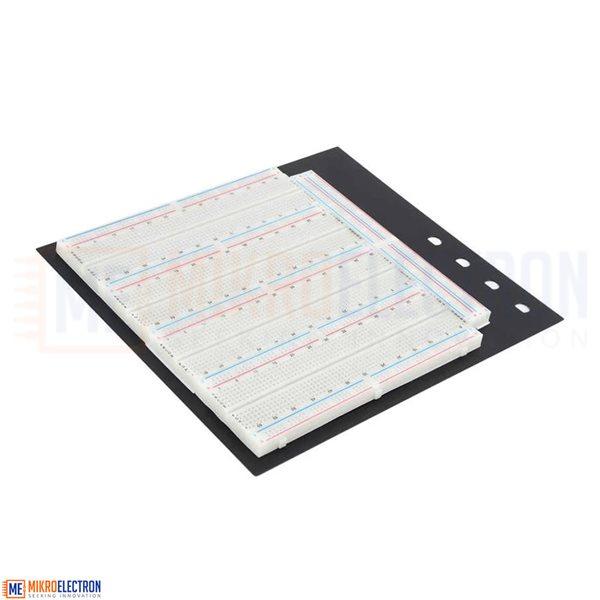
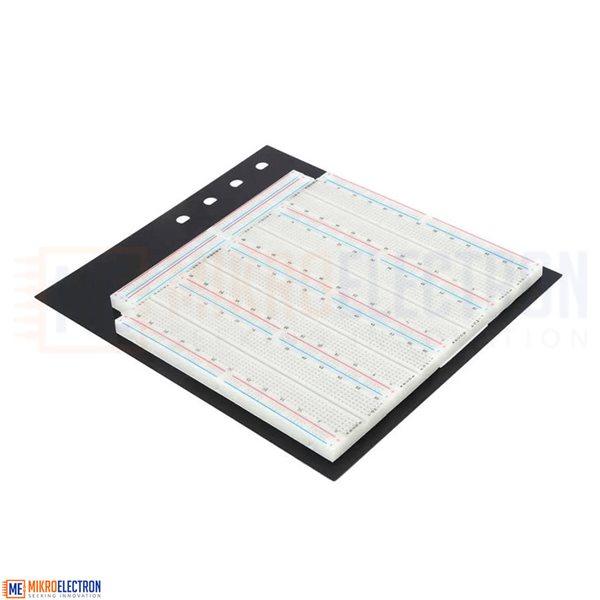
The board features a sturdy ABS plastic construction with a rigid aluminum backing plate, providing mechanical stability and preventing warping during use. The modular design allows individual breadboard units to be assembled, separated, and rearranged to suit different project layouts. The internal phosphor-bronze contact reeds provide firm, low-resistance connections for wires with a diameter of about 0.8mm (equivalent to 20–29 AWG solid-core wire).
Usage Notes:
- Components should be inserted vertically into the square holes, and you should feel a slight, uniform friction resistance.
- When the breadboard is turned upside down, well-inserted components should remain in place without falling off.
- Never insert pre-soldered components or thick leads into the breadboard — this can permanently damage the contact reeds.
- Store the breadboard in a dry, ventilated location, and keep it away from leaking battery electrolyte or other corrosive substances to preserve its lifespan.
Specifications
| Parameter | Value |
|---|---|
| Item Type | Solderless Breadboard |
| Total Tie Points | 3220 points |
| Terminal Strips | 4 strips / 2520 jacks |
| Distribution (Power) Strips | 7 strips / 700 jacks |
| Power Terminals (Binding Posts) | 4 |
| Body Material | ABS plastic |
| Backing Plate | Aluminum |
| Accepted Wire Diameter | ~ 0.8 mm |
| Accepted Wire Gauge | 20 – 29 AWG solid core |
| Maximum Voltage | 300 V |
| Maximum Current | 3 – 5 A |
| Assembly | Modular — units can be combined |
| Purpose | Prototyping, experiments, robotics, education |
Applications
- Prototyping microcontroller projects (Arduino, ESP32, Raspberry Pi, STM32, PIC)
- Building analog and digital circuits with ICs, op-amps, logic gates, and 555 timers
- Testing sensor modules, motor drivers, and communication ICs before final PCB design
- Educational demonstrations in schools, universities, and electronics workshops
- Robotics and automation project development
- Circuit design experiments and breadboard-based labs
- Hobbyist and maker projects — DIY electronics, IoT, smart-home prototypes
- Rapid iteration of circuit ideas before committing to soldered boards
- Debugging and fault-finding of existing designs
- Training environments for teaching basic and advanced electronics